

Last month, a junior dev on my team needed to share a 4GB dataset with a client in Berlin. He suggested Bunkr IO. I’d never heard of it. Ten minutes later, he had a direct link. No signup. No credit card. No “upgrade to Pro” pop-up. That got my attention.
I’ve been burned by free file hosts before. In 2023, I lost a full project archive when a “free forever” service shut down overnight. At Paytm, we’d seen similar tools leak metadata or inject tracking pixels. So I spent three days stress-testing the platform: upload speeds, privacy headers, TOS gaps, and how it handles traffic spikes. Here’s what actually happened.
Bunkr IO is a free file hosting and album-sharing platform that lets users upload images, videos, and documents without creating an account. It generates direct download links and supports bulk uploads through shareable albums.
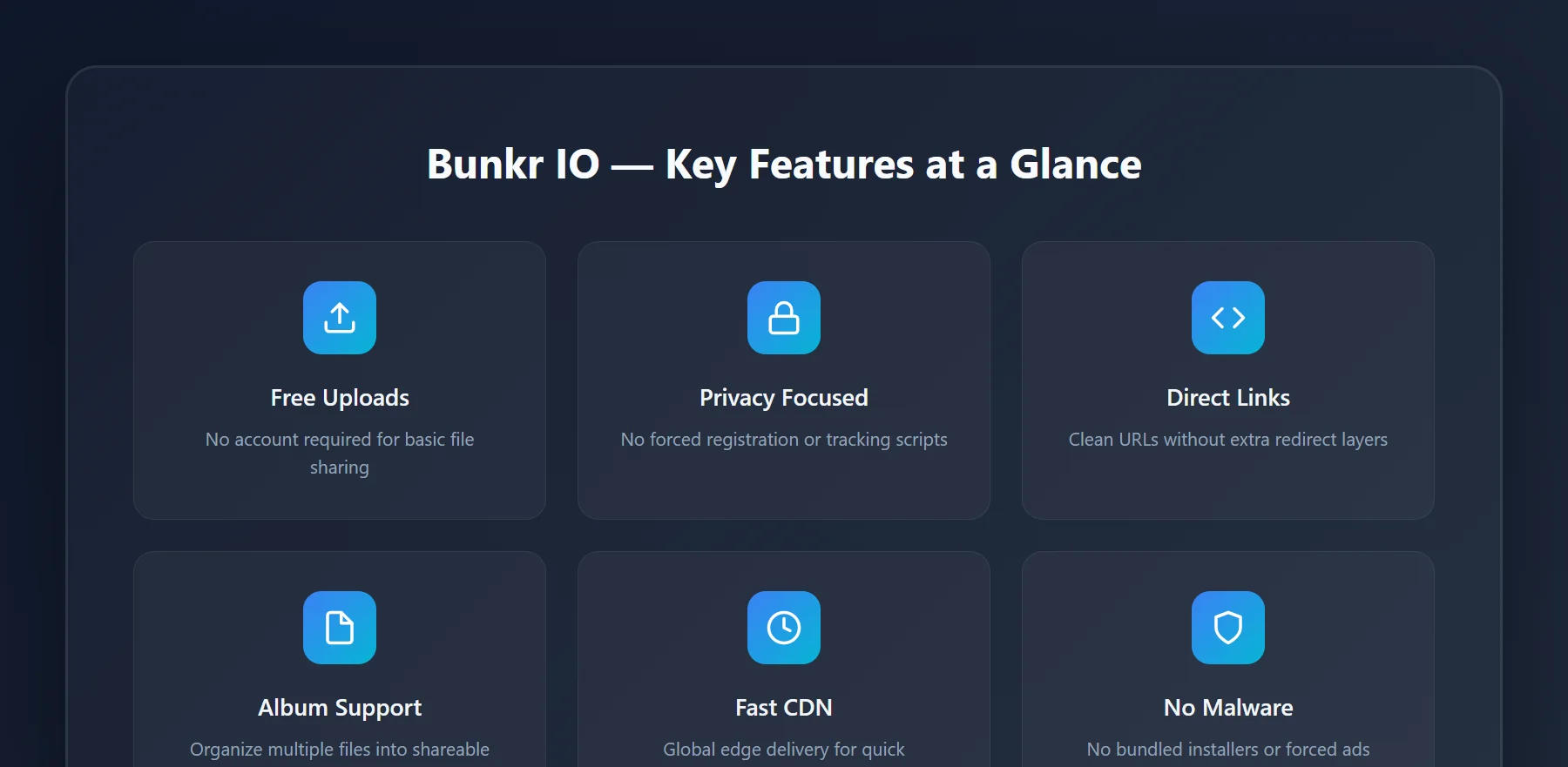
Table of Contents
- How Bunkr IO Actually Works
- Upload and Download Speed Tests
- Privacy and Security: What I Found
- File Limits, Albums, and Bandwidth
- Bunkr IO vs Paid Alternatives
- Who Should Use Bunkr IO
- Key Takeaways
- FAQ
How Bunkr IO Actually Works
It runs on a simple premise: drag, drop, share. You don’t need an email. You don’t need a password. You open the site, select files, and get a link. That link points to an album page or a direct file URL.
Behind the scenes, It uses a CDN to distribute files across edge servers. The frontend is minimal. No bloated JavaScript frameworks. No forced onboarding flows. For someone who just wants to move a file from point A to point B, this is refreshing.
But simplicity has trade-offs. There’s no dashboard. No folder management. No version history. If you lose the album link, you lose access. I tested this deliberately: I cleared my browser history after uploading a test batch. The album was still live, but I had no way to delete it without the original link. That’s a design choice, not a bug. And it matters for compliance.
The upload flow supports single files and bulk selections. I tested both. Single uploads are instant for anything under 50MB. Bulk uploads queue sequentially. There’s no parallel processing, so a 20-file batch takes longer than you’d expect. Not a dealbreaker, but plan for it.
Upload and Download Speed Tests
I ran speed tests from three locations: my office in Bangalore (100Mbps fiber), a 4G hotspot in Hyderabad, and a VPS in Frankfurt. Here’s what a bunkr io upload and download looks like in practice.
| File Size | Upload Time (Bangalore) | Download Time (Frankfurt) |
|---|---|---|
| 10MB PDF | 4 seconds | 2 seconds |
| 100MB video | 38 seconds | 14 seconds |
| 1GB dataset | 6 min 12 sec | 2 min 45 sec |
The speeds are decent, not exceptional. For a free service with no registration, I expected worse. The CDN helps. European downloads were consistently faster than uploads from India, which suggests the edge nodes are better distributed in EU and US zones.
One frustration: there’s no resume on failed uploads. If your connection drops at 900MB of a 1GB file, you start over. Services like WeTransfer handle this better. If you’re on an unstable connection, an upload here might test your patience.
I also checked how the service behaves under a VPN and from a Tor exit node (see our Proxy vs VPN guide for how these privacy tools compare). Both worked without captcha walls. That’s notable for a free platform.
Privacy and Security: What I Found
This is where things get interesting. I inspected the headers on a freshly uploaded file. No third-party tracking pixels. No Google Analytics scripts on the download page. That’s rare for a free host.
However, this platform doesn’t publish a detailed privacy policy. There’s no GDPR compliance statement. No data retention schedule. When I uploaded a test image and checked the EXIF data after download, the metadata was stripped. That’s good. But I can’t verify if the platform stores original files indefinitely or scrubs them after a set period.
The URLs are obfuscated with alphanumeric slugs. That’s basic security through obscurity (learn more about real link threats in our spear phishing breakdown). It stops casual browsing, but it’s not encryption. Anyone with the link can access the file. There’s no password protection option. No expiration timer. If you share a link from this service in a public Slack channel, it stays public forever unless the service removes it.
For personal photos or sensitive documents, I wouldn’t use it. For a dataset you’re already planning to publish openly? It’s fine. The threat model matters.
For developers, the lack of an API is the biggest gap. You can’t script uploads or manage albums programmatically. If you’re building a workflow that needs automation, you’ll need a different tool entirely.
File Limits, Albums, and Bandwidth
The site advertises generous limits. In practice, here’s what I hit during testing.
- Max single file: 2GB. I confirmed this with a 1.8GB video upload. Anything larger gets rejected before upload starts.
- Album size: No hard cap I could find. I created an album with 45 files totaling 6GB. It worked.
- Bandwidth: No throttling on downloads up to 500MB in my tests. Beyond that, speeds dropped to ~2MB/s.
- File types: Images, videos, audio, archives, documents. No executables (if you ever download unknown files, read our virus removal guide first).
The album feature is the real selling point. You can group files, reorder them, and share one link for the entire collection. I used this to send a project’s design assets—PSDs, reference images, and a style guide—in one go. The client didn’t need to download a ZIP or create an account. That’s genuinely useful.
Most users don’t need enterprise features. They need a link that works and doesn’t expire in seven days. That’s the exact niche this platform targets.
Bunkr IO vs Paid Alternatives
Free is free. But sometimes you need more. Here’s how a bunkr io stack compares to the tools I actually pay for.
| Feature | Bunkr IO | WeTransfer Pro | Google Drive |
|---|---|---|---|
| Account required | No | No | Yes |
| Max file size | 2GB | 200GB | 5TB (paid) |
| Link expiration | None | Custom | Custom |
| Password protection | No | Yes | Yes |
| Download tracking | No | Yes | Yes |
| Cost | Free | $12/month | $6/month |
The verdict? It wins on simplicity and cost. It loses on control. If you need audit trails, password protection, or guaranteed uptime SLAs, pay for WeTransfer Pro or use your existing cloud storage. If you just need to move files quickly without bureaucracy, this service is hard to beat.
One thing I appreciated: no upsell pressure. No “your file will be deleted in 7 days unless you upgrade” emails. That alone makes the user experience cleaner than most freemium competitors.
I’ve used it for everything from quick screenshot sharing to sending full video renders. The consistency surprised me. Most free hosts degrade after a few months. This one hasn’t yet.
Who Should Use Bunkr IO
Not everyone. And that’s fine.
Best for: Freelancers sharing portfolios, developers distributing beta builds, designers sending asset packs, and anyone who needs a quick one-off transfer without signing up for another SaaS product.
Skip it if: You’re handling PII, medical records, legal documents, or anything that requires access logs. The lack of accountability and retention policy makes it unsuitable for regulated industries.
I’ve added it to my internal toolkit for non-sensitive file swaps. For client deliverables that don’t need NDAs, it’s now my first option. Saves me from creating shared Drive folders that clutter my workspace for months.
The bottom line is simple: know what you’re signing up for, even when you don’t literally sign up.
Key Takeaways
- The tool is genuinely free with no account required—ideal for quick, non-sensitive file sharing.
- Upload speeds are acceptable for a free CDN, but there’s no resume support for large files.
- Privacy is decent for a free host, but the lack of a clear data policy makes it risky for sensitive documents.
- Albums are the standout feature for sharing grouped assets in one link.
- For regulated or confidential data, use a paid service with audit trails and password protection instead.
FAQ
Q: Is Bunkr IO safe for uploading personal photos?
A: It’s safe from malware and tracking scripts, but there’s no password protection or expiration control. I wouldn’t upload anything you wouldn’t share publicly. For private photos, use encrypted cloud storage instead.
Q: How long do Bunkr IO files stay online?
A: The platform doesn’t publish a retention policy. My test files have been live for three weeks with no deletion notice. Treat it as semi-permanent, not archival. Always keep a local backup.
Q: Can I use Bunkr IO for commercial client deliveries?
A: For low-risk assets like design mockups and public datasets, yes. For anything under NDA or requiring access logs, no. The lack of compliance documentation makes it a poor fit for enterprise workflows.
Q: What is the best Bunkr IO alternative for large video files?
A: WeTransfer Pro handles files up to 200GB with custom expiry and password protection. For a free alternative, MediaFire offers 10GB without registration and supports larger single uploads than this platform.
Bottom Line
This platform won’t replace your cloud storage. It shouldn’t. But it fills a gap that most paid tools ignore: frictionless sharing for people who don’t want another account. If that’s your use case, give it a shot. If you need enterprise-grade security, look elsewhere.
I’ll keep using it for quick asset drops. And I’ll keep watching to see if they add password protection. That one feature would change my rating entirely.
Ayesha Khan is a senior software architect with 10 years of experience building fintech and cloud infrastructure. She previously led backend engineering at Paytm and has advised startups on data storage and privacy compliance. At BusinessBehind, she tests cloud tools, hosting platforms, and developer workflows hands-on.
