

The first time I watched a crisis operation fall apart, every piece of equipment was green. Radios checked out. Channels were clear. The failure was quieter than that. Two team leads used the same word for two different landmarks. Neither realized it until units were in the wrong positions. The network was fine. The communication wasn’t.
That’s the gap most people miss. Tactical communication isn’t just about radios, waveforms, or encryption. It’s also about the discipline to say the right thing clearly when the pressure is on. One without the other gives you noise. You need both.
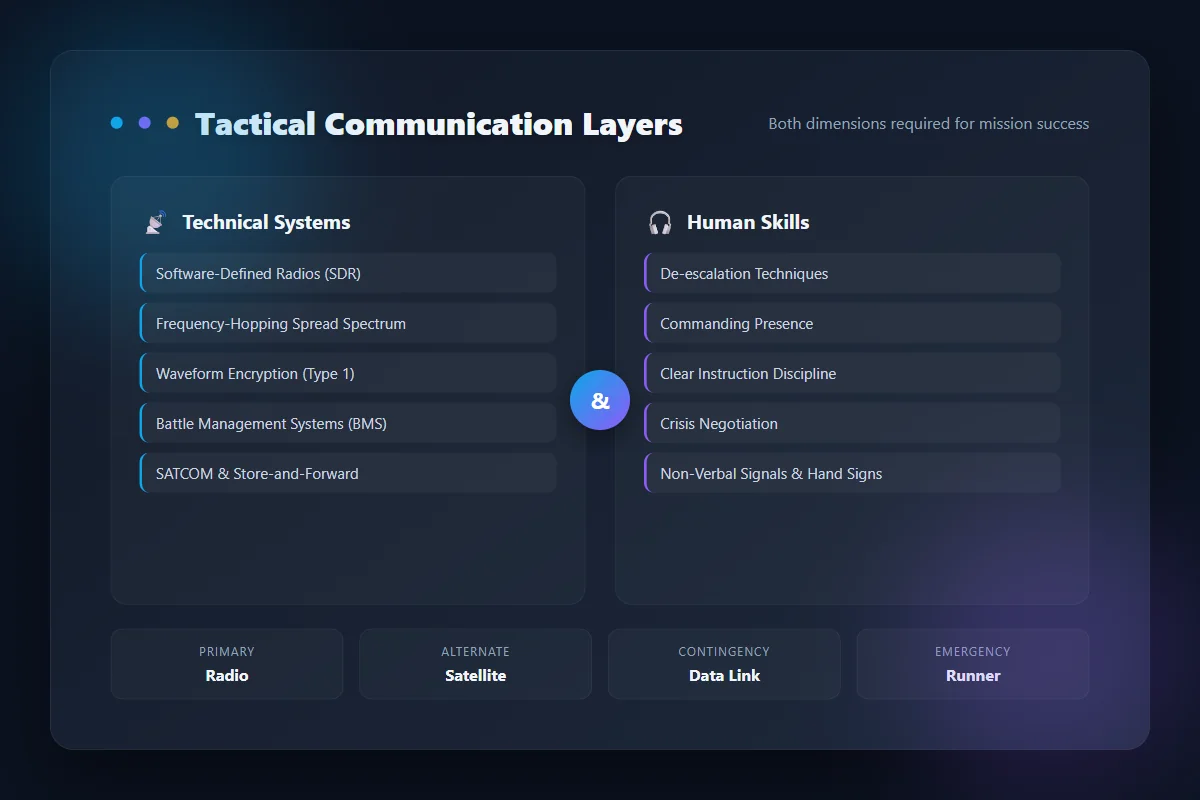
Tactical communication is the combined practice of moving critical information accurately under pressure through both technical systems and human skill.
Table of Contents
- What Tactical Communication Actually Means
- How Tactical Systems Work
- Interoperability: The Unsolved Problem
- Resilience in Jammed and Disconnected Environments
- The Human Side: De-escalation and Presence
- Non-Verbal Communication Under Pressure
- Crisis Negotiation
- Where Tactical Communication Fails
- Frequently Asked Questions
What Tactical Communication Actually Means
Most people hear “tactical communication” and think of military radio chatter. That’s only half the picture. The term covers two distinct domains that depend on each other.
In defense and military contexts, tactical communication means the voice, data, and video networks that connect units in the field. Hardware, software, waveforms, encryption, and battle management systems all fall under this definition. These systems have to work across terrain, through interference, and without relying on fixed infrastructure.
In security, law enforcement, and emergency response, tactical communication means the disciplined exchange of information under stress. De-escalation, commanding presence, clear instructions, and crisis negotiation are the tools here. No radio required. Just words, tone, and body language used with precision.
The two aren’t competing. A soldier needs the radio to reach command and the discipline to say the right thing when they do. A law enforcement officer in a crisis needs the radio to coordinate backup and the human skills to manage the scene. Both dimensions matter. Skip either one, and you’re gambling with the outcome.
How Tactical Systems Work
Modern military tactical networks are built around software-defined radios (SDRs). Unlike legacy radios where the waveform is locked into circuitry, an SDR runs its communication functions in software. The hardware handles the RF signal. The software defines the waveform, frequency-hopping pattern, encryption, and data protocol.
This matters because it means a deployed radio can be updated without replacing hardware. New encryption standard? Software update. New interoperability waveform? Software update. In a field where equipment lifecycles stretch over decades, that flexibility is the difference between obsolescence and relevance.
Battle management systems (BMS) sit above the radio layer. These platforms integrate communications with mapping, sensor feeds, intelligence, and logistics into a single common operating picture. When position data, status reports, and sensor feeds flow into a BMS, commanders can see the battlespace in real time instead of working from stale reports.
Satellite communication (SATCOM) extends the network beyond line-of-sight radio range. A unit in terrain where ground-based links can’t reach can still connect through satellite. The trade-off is latency and bandwidth. Satellite links introduce delay and lower throughput than direct radio. That affects what you can stream and how fast you can react.
I’ve worked with similar network architectures in fintech disaster-recovery planning. The principles translate. When your primary data link dies, you need alternate paths. When your command node goes offline, distributed decision-making has to keep working. The military solved these problems first. Enterprise is still catching up. If you’re comparing secure network strategies, see our breakdown of proxy vs VPN differences.
Interoperability: The Unsolved Problem
Interoperability is the ability of different systems and organizations to communicate and work together. In tactical communication, it’s one of the hardest problems and one of the most valuable outcomes.
I saw this fail during a joint exercise. Two units arrived with radios on the same frequency but different encryption keys. They could see each other’s signals on a spectrum analyzer. They couldn’t exchange a single word. The workaround was runners moving between command posts. In a real operation, that delay could cost lives.
The problem is legacy. Military radio systems were developed by different nations, different services, and different contractors over decades. The result is a landscape of incompatible equipment. Replacing it all is expensive and slow. Gateway devices that translate between waveforms work in the short term, but they’re a patch, not a solution.
The real fix is common waveform standards. The ESSOR project develops a waveform family that allows SDRs from different national manufacturers to communicate during multinational operations. The goal is straightforward: any ESSOR-compliant radio, regardless of who built the hardware, speaks the same language. It’s not perfect. But it’s progress.
This problem exists outside the military too. In my previous role, we merged with a company running a completely different cloud stack. The “gateway” was a set of brittle integration scripts that failed every quarter. Interoperability isn’t a solved problem anywhere. It’s just managed better in some places than others. For another take on security integration challenges, see how spear phishing attacks exploit exactly these communication gaps.
Resilience in Jammed and Disconnected Environments
Tactical networks are designed to operate while an adversary is actively trying to break them. That changes the engineering requirements significantly.
Frequency-hopping spread spectrum is the first line of defense against jamming. Instead of transmitting on one fixed frequency, the radio hops rapidly across a range according to a predetermined sequence. Only a receiver that knows the pattern can follow the signal. A jammer has to cover a much wider bandwidth, which takes exponentially more power. And a pseudo-random hopping sequence makes predicting the next frequency nearly impossible.
Waveform encryption adds a second layer. Type 1 encryption, certified by the NSA for classified traffic, protects both content and metadata. An adversary who captures the RF signal gets unusable noise without the cryptographic keys.
But radios fail. Jamming works sometimes. Terrain blocks signals. Batteries die. That’s why tactical doctrine emphasizes PACE planning: Primary, Alternate, Contingency, and Emergency communication methods. If the primary radio fails, you switch to the alternate. If that fails, the contingency takes over. The emergency method is your last resort. Operators who only train on the primary system have no options when it goes down.
Store-and-forward messaging keeps communication alive when the link to headquarters is intermittent. Messages are stored locally and transmitted when connectivity returns. In disconnected, degraded, intermittent, and limited-bandwidth environments, local processing and distributed architecture aren’t optional features. They’re survival mechanisms.
I used a civilian version of this during a fintech platform migration. Our WAN link to the primary data center dropped for six hours. Local queues held transaction data. When the link returned, everything synchronized. The principle is identical. Only the stakes are different.
The Human Side: De-escalation and Presence
Technical systems deliver information. Human skill determines whether that information does anything useful.
I learned this during crisis response training. The scenario was an armed individual and a hostage in a confined space. My radio was working. Backup was in position. The equipment did its job. What failed was my opening communication with the individual. I misread his tone, responded too aggressively, and made the situation worse. The instructor stopped the exercise and said, “Your equipment worked perfectly. You didn’t.”
De-escalation is the hardest communication skill in high-stress environments. It means staying calm when calm isn’t natural. It means acknowledging someone’s emotions without becoming emotional yourself. It means guiding the conversation toward resolution when the other person is already in crisis. Calling it an “art” makes it sound easier than it is. The reality is repetitive, realistic practice under stress until the right responses become automatic.
Commanding presence works alongside de-escalation. It’s establishing authority without confrontation through posture, tone, and deliberate movement. Not volume. Not aggression. Experienced officers enter a chaotic scene with a clear sense of control, and people naturally look to them for direction. That presence is trained. It doesn’t happen by accident.
Clear instructions under pressure are harder than they sound. Stressed people use vague references: “over there” instead of coordinates, “the vehicle” without specifying which one, “handle it” without explaining how. In a tactical environment, vague instructions produce vague actions. The discipline of giving instructions that can’t be misunderstood, specific, unambiguous, and confirmed, has to be deliberately drilled. It is not automatic.
Non-Verbal Communication Under Pressure
In environments where verbal communication isn’t practical, non-verbal signals take over. Military hand signals have specific, trained meanings. A closed fist means stop. A circular motion overhead means rally at that location. Pointing followed by fingers indicates direction and distance to a threat. These signals work because every member of the unit trained on the same meanings until the responses became automatic.
Eye contact and body orientation communicate command authority during close operations. An experienced operator can redirect team members, signal readiness, or indicate a threat through eye movements and body positioning that an opponent won’t notice but teammates read instantly.
Physical positioning also communicates without words. Where someone stands, how much space they occupy, and the direction they face can communicate intent and risk level. In close protection and law enforcement, body positioning is deliberately used to establish control of a space before any verbal exchange happens.
Crisis Negotiation
Crisis negotiation is the most complex application of human tactical communication. In a hostage situation, armed standoff, or barricaded subject, the negotiator’s only tool is communication. Words, tone, pacing, and the ability to build enough rapport with someone in crisis to guide them toward a peaceful resolution.
Active listening is the foundation. It means listening to understand, not listening while preparing your next response. A person in crisis usually isn’t looking for logic first. They want to feel heard. A negotiator who genuinely understands the other person’s perspective, even when they disagree with their actions, creates the psychological conditions for them to consider alternatives.
Labeling emotions is one useful technique. Calmly identifying what the other person appears to be feeling without judging them. For example, saying, “It sounds like you feel there’s no other option.” That doesn’t mean agreement. It shows attention. It builds trust. It creates an opening for alternative solutions.
Time is also a tool. Extended conversation gives the person time to process, allows emotions to rise and settle, and gives tactical teams more preparation time. A negotiator who keeps the person talking isn’t necessarily failing to resolve things quickly. They may be guiding the situation toward the least harmful outcome.
Where Tactical Communication Fails
The failures I’ve seen, and the ones documented in after-action reports across both military and civilian operations, cluster around predictable patterns.
Assuming shared understanding. Two operators use the same word to mean different things. Neither notices until the action reveals the disconnect. Standard procedures and confirmed read-backs exist to prevent this. When people skip confirmation because they’re confident the message was understood, this failure mode reappears.
Communication under cognitive load. Under stress, cognitive bandwidth narrows. People revert to shorthand, omit critical details, and fail to notice that the other person hasn’t actually understood. Training under realistic stress builds the automatic behaviors that survive cognitive load. Untrained communication under stress produces failures that look inexplicable in review.
Interoperability assumptions. Assuming a partner unit can communicate with yours without verifying it in advance. This happens in joint exercises and real operations more often than anyone wants to admit. The verification step takes minutes. The failure it prevents can last hours.
Over-reliance on primary systems. When the primary system fails, operators who haven’t maintained proficiency with backup systems have no options. PACE planning exists because no single method is completely reliable. Operators with only one communication method have no options when it fails.
Key Takeaways
- Tactical communication has two layers: technical systems and human discipline. Neither works without the other.
- Software-defined radios and common waveforms like ESSOR are solving interoperability, but legacy equipment makes it slow.
- PACE planning — Primary, Alternate, Contingency, Emergency — is non-negotiable for mission-critical communication.
- De-escalation, commanding presence, and clear instructions are trained skills, not natural reactions under stress.
- The most expensive failures happen when systems work perfectly but people assume they share the same understanding.
Frequently Asked Questions
What is the difference between tactical communication in military and law enforcement contexts?
In military contexts, tactical communication refers primarily to the networked systems — radios, waveforms, encryption, and battle management platforms — that connect units in the field. In law enforcement and security, it refers primarily to interpersonal skills: de-escalation, commanding presence, clear instructions, and crisis negotiation. In practice, both domains require both dimensions. A soldier needs radio systems and communication discipline. A law enforcement officer needs radio coordination and interpersonal skills. The emphasis differs by context. The requirement for both does not.
What is a software-defined radio and why does it matter?
A software-defined radio implements communication functions — waveform, frequency hopping, encryption — in software rather than fixed hardware. This means the radio can be updated to support new standards or waveforms through a software update instead of hardware replacement. For tactical communications, this matters because it allows deployed radios to maintain interoperability with allies, incorporate improved encryption, and support new capabilities without replacing physical hardware in the field.
What does PACE planning mean in tactical communications?
PACE stands for Primary, Alternate, Contingency, and Emergency — four pre-planned communication methods for a given mission. If the primary method fails, the alternate is used. If the alternate fails, the contingency takes over. The emergency method is the last resort. PACE planning exists because no single communication method is completely reliable in all environments. Operators who rely on only one method have no options when it fails.
Why is interoperability so difficult in tactical communications?
Interoperability requires compatible waveforms, frequency plans, and encryption. Military radio systems were developed by different nations, services, and contractors over decades, producing a landscape of incompatible equipment. Achieving interoperability requires replacing all systems with compatible hardware, using gateway devices that translate between incompatible systems, or adopting common waveform standards like ESSOR. All three approaches are in use, and none fully resolves the problem in multinational operations involving legacy equipment.
Can crisis negotiation skills be learned, or are they innate?
Crisis negotiation is a trained skill, not an innate talent. The core competencies — active listening, emotion labeling, rapport building, and maintaining composure under pressure — are developed through repetitive, realistic practice. Experienced negotiators are not born with these abilities. They have practiced them in controlled environments until the techniques become automatic. The difference between a trained negotiator and an untrained one is preparation, not personality.
