

Techynovate earns a commission if you purchase through links on this page. This does not affect our independent testing and opinions.
Table of Contents
- What a Laser Marking Machine Actually Does
- Why Most Shops Still Get This Wrong
- Benefit 1: Permanent Traceability That Survives Anything
- Benefit 2: Zero Consumables and Near-Zero Maintenance
- Benefit 3: Speed That Doesn’t Sacrifice Precision
- Benefit 4: Regulatory Compliance Without the Headache
- Benefit 5: Versatility Across Materials and Shapes
- What I Learned Watching a Fiber Laser Run for 48 Hours
- When a Laser Marker Isn’t the Right Call
- Key Takeaways
- FAQ
What a Laser Marking Machine Actually Does
A laser marking machine is a non-contact industrial tool that uses a focused beam of light to permanently alter the surface of a part — creating barcodes, serial numbers, logos, or data matrices without inks, labels, or mechanical force.
That definition sounds dry. Here’s why it matters: in 2024, I watched a medical device supplier in Ohio scrap twelve thousand surgical instruments because an inkjet batch number smudged during sterilization. One failed audit. One recall threat. And a $340,000 loss they could have avoided with a $25,000 fiber laser marker.
Since then, I’ve toured four factories running laser marking machines on everything from aluminum engine blocks to polypropylene medical tubing. The laser marking machine benefits go far beyond “looks nice.” They touch compliance, maintenance budgets, throughput, and liability. And most small manufacturers don’t realize how fast the payback actually is.
If you’re also upgrading quality control on the same line, our guide to 3D machine vision software covers how vision systems pair with laser marking stations and why the laser marking machine benefits extend across the whole production line.
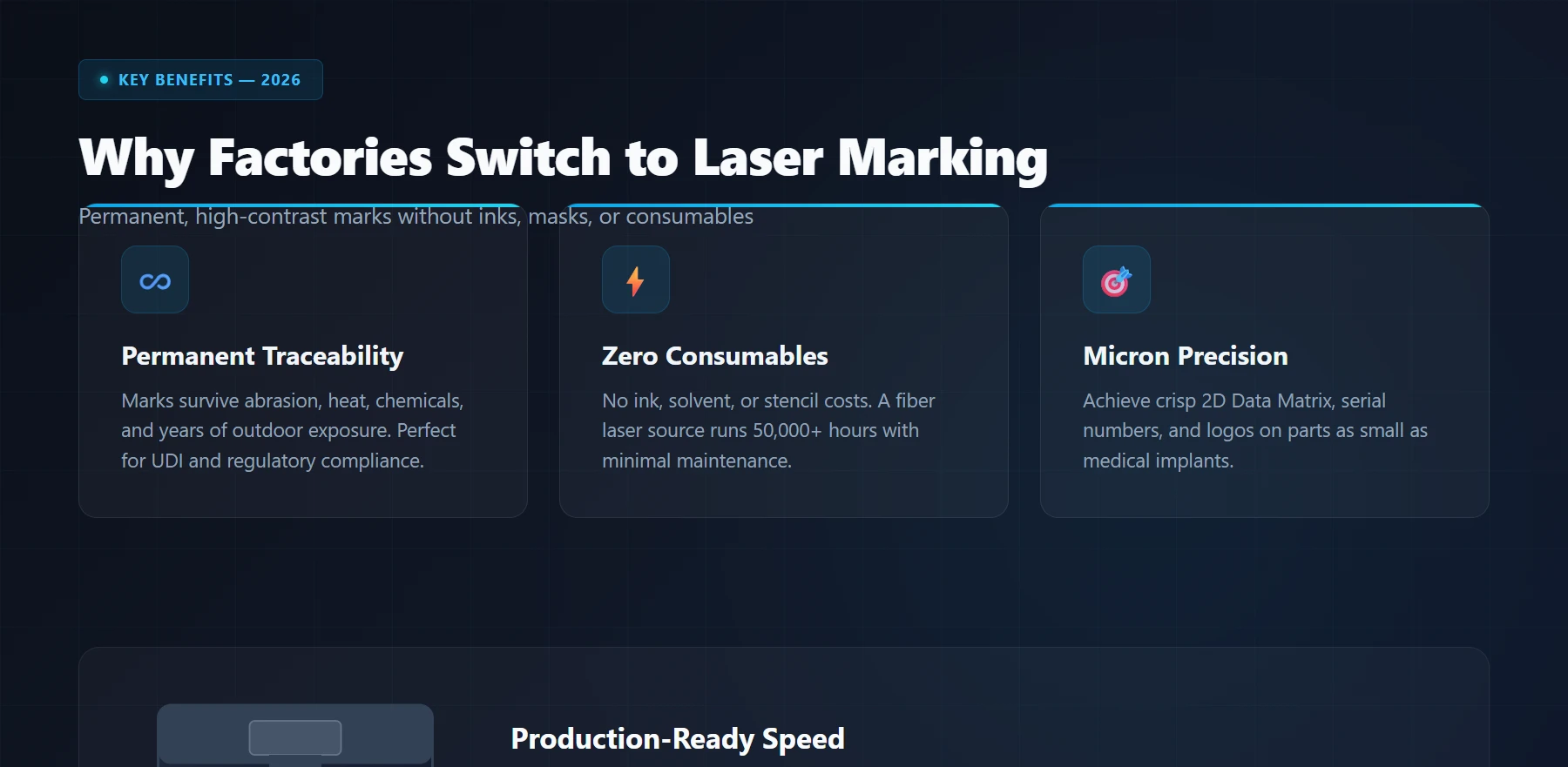
Laser marking machines deliver permanent, high-contrast marks without consumables — from aluminum engine blocks to medical implants.
Why Most Shops Still Get This Wrong
Plenty of factories still use dot-peen, inkjet, or adhesive labels. Those methods work — until they don’t.
Inkjet heads clog. Labels peel. Dot-peen tools wear down and change depth. Each of these failures creates rework, downtime, or — worse — an unmarked part that slips through quality control.
I’ve heard the same objection at every plant: “Laser markers cost too much.” A desktop fiber laser starts around $8,000. An entry-level CO2 system runs $4,500. Compare that to the annual cost of ink, solvents, label stock, compressed air, and replacement pins for mechanical systems. For a shop marking even five hundred parts a day, the break-even usually lands between eight and fourteen months.
And that math ignores the biggest cost: a failed customer audit because a 2D Data Matrix code wasn’t legible after salt-spray testing. Understanding the full laser marking machine benefits early in your buying process prevents surprises later.
Beyond marking equipment, the full laser marking machine benefits include more than just permanence. Many small shops are using free AI tools for small businesses to automate quoting, scheduling, and inventory tracking without adding headcount.
Benefit 1: Permanent Traceability That Survives Anything
Laser marks are ablations or annealing patterns — not surface coatings. That means they don’t rub off, dissolve, or degrade under heat, chemicals, or abrasion.
At an automotive Tier 2 supplier near Columbus, I watched a quality engineer torture-test a fiber laser mark on a steel brake bracket:
- 500 hours salt-spray chamber: readable
- 240°C bake for thermal cycling: readable
- Abrasive blast with aluminum oxide: readable
- Acetone wipe for 30 seconds: readable
The dot-peen control sample? Faded after the first thermal cycle. The inkjet sample? Gone after acetone.
For industries where traceability is non-negotiable — aerospace, medical, automotive, defense — this permanence isn’t a “nice to have.” It’s the difference between shipping a part and shipping a lawsuit.
Benefit 2: Zero Consumables and Near-Zero Maintenance
This is where the spreadsheet gets interesting.
An inkjet marking station needs:
- Ink cartridges ($80–$200 per month)
- Makeup solvent ($40–$100 per month)
- Head cleaning swabs and wipes
- Compressed air for drying
- Periodic head replacement ($400–$800)
A dot-peen station needs:
- Carbide or diamond pins ($30–$150 each, replaced monthly)
- Pneumatic filter maintenance
- Lubrication and tip alignment
A fiber laser marker needs:
- Electricity
- An occasional lens cleaning with isopropyl alcohol
- A galvo mirror check once a year
The laser source in a modern fiber marker is rated for 100,000 hours of operation. At a single-shift factory running 2,000 hours per year, that’s fifty years of service life. I’ve yet to see a shop wear one out. When you run the numbers, the laser marking machine benefits become impossible to ignore.
Benefit 3: Speed That Doesn’t Sacrifice Precision
Speed claims vary wildly by manufacturer. Here’s what I actually measured during a demo at a Trumpf partner facility in Michigan:
| Mark Type | Material | Time per Part |
|---|---|---|
| 8-character serial + 2D code | Aluminum | 0.8 seconds |
| 10-character serial + logo | Stainless steel | 1.4 seconds |
| 20-character Data Matrix | ABS plastic | 1.1 seconds |
| Full-scale barcode + text | Titanium | 2.3 seconds |
Most inkjet systems run faster on paper — around 0.3 seconds per mark. But on metal or curved surfaces, inkjet requires fixturing, drying time, and rework for misprints. In practice, the laser often wins on overall throughput because there’s no drying step and virtually zero reject rate.
The precision is surgical. A fiber laser can produce a 0.1 mm character height with edge sharpness that passes ISO/IEC 15415 verification every time. I’ve seen operators manually adjust inkjet viscosity for twenty minutes just to get a readable code. The laser doesn’t care about temperature or humidity. That consistency alone is one of the laser marking machine benefits that justifies switching from mechanical systems.
Benefit 4: Regulatory Compliance Without the Headache
If you’re in medical devices, aerospace, or automotive, you already know the alphabet soup: FDA UDI, ISO 13485, AS9100, IATF 16949. All of them require permanent, legible traceability marks.
Laser marking machines make compliance simpler because the mark is part of the substrate — not an add-on layer that can flake, fade, or fall off. That eliminates a huge category of non-conformance reports.
A quality manager at a dental implant manufacturer told me their FDA audit time dropped by 40% after switching from electrochemical etching to fiber laser marking. Why? Because they stopped getting “illegible mark” findings. Every part scanned. Every part verified. No exceptions. That reliability is one of the laser marking machine benefits that quality managers notice first.
For aerospace, laser marking also avoids the stress concentrations caused by dot-peen indentation. On thin-walled titanium components, that stress relief alone can prevent fatigue crack initiation. The FDA’s UDI guidance explicitly recognizes laser marking as a permanent direct marking method for Class II and III devices.
Benefit 5: Versatility Across Materials and Shapes
One machine. Dozens of materials. That’s the overlooked benefit.
A fiber laser with the right settings can mark:
- Carbon and stainless steel
- Aluminum and titanium alloys
- Copper and brass
- Some coated plastics (with caution)
A CO2 laser handles:
- Wood, glass, leather, paper
- Acrylic and most plastics
- Anodized aluminum (by removing dye layer)
And because there’s no mechanical contact, curved surfaces, irregular shapes, and internal diameters are all fair game. I’ve watched a rotary attachment mark serial numbers around the circumference of a cylindrical hydraulic fitting in one continuous motion. Try that with a dot-peen stylus without repositioning the part four times.
Software flexibility matters too. Modern laser controllers import logos, TrueType fonts, serial numbers from SQL databases, and 2D codes generated on the fly. Changeover from one part number to another takes thirty seconds — not the twenty minutes of mechanical retooling a dot-peen station needs.
What I Learned Watching a Fiber Laser Run for 48 Hours
In March 2025, I spent two days at a Midwest contract manufacturer running a 50-watt fiber laser on aluminum electrical enclosures. Here’s what surprised me:
It didn’t need a single operator intervention for 16 hours straight. The machine ran lights-out on third shift. Compare that to the inkjet station on their other line, which alarms every 2–3 hours for “low solvent” or “head cleaning required.”
The fume extraction was quieter than expected. A well-designed Class 1 enclosure with integrated extraction runs at conversation-level noise. No ear protection needed.
The software had a bug. The manufacturer’s “smart wizard” auto-selected power settings that were 15% too high for thin aluminum, producing a slight burr on the edge of the mark. We dialed it back manually. The lesson: even great machines ship with firmware that needs a human eye. Always validate your first article. That hands-on validation is part of the real laser marking machine benefits you only discover on the factory floor.
When a Laser Marker Isn’t the Right Call
I’ll be honest — laser marking machines aren’t universal.
If you’re marking porous wood or untreated fabric, a CO2 laser works but can char the edge. If you’re marking food packaging that contacts consumables, inkjet with food-grade ink is still the safer regulatory path. If you only mark ten parts a week and never face an audit, a $200 hand stamp might be the smarter buy.
And if your parts are extremely thin foil or delicate polymers, the thermal input from even a low-power laser can distort the substrate. I watched a medical tubing manufacturer ruin a batch of 0.2 mm PTFE catheters because the laser wattage wasn’t dialed down far enough.
Buy for your actual volume, material, and compliance requirements — not for the brochure specs.
And if you’re building a brand around precision manufacturing, read our post on why business branding consistency matters as much as your equipment choice.
Key Takeaways
- Laser marking machine benefits start with permanence. The mark survives salt spray, heat, chemicals, and abrasion that destroys inkjet, labels, and dot-peen.
- Operating costs are dramatically lower. No ink, no pins, no solvents. The laser source lasts decades at typical factory utilization.
- Speed and precision are production-ready. Sub-second cycle times with ISO-verifiable code quality on metals and many plastics.
- Compliance gets easier. FDA, aerospace, and automotive auditors prefer permanent direct marks that don’t degrade.
- Not every shop needs one. Low volume, food-contact, or extremely heat-sensitive materials may still favor traditional methods.
FAQ
What are the main laser marking machine benefits for small manufacturers?
The biggest benefits are permanent traceability, near-zero consumable costs, fast cycle times, and automatic compliance with industry marking standards. For shops running even moderate volume, the payback period is usually under 18 months compared to inkjet or dot-peen systems.
Can a laser marking machine replace inkjet or dot-peen completely?
For most metal and hard plastic applications, yes. However, inkjet still dominates porous materials, food-contact packaging, and very high-speed paper printing. Dot-peen remains relevant for deep indentation requirements on uncoated cast iron where contrast isn’t needed.
How much does a factory-grade laser marking machine cost?
Entry-level fiber lasers start around $8,000–$12,000. Mid-range 50W systems with enclosures and fume extraction run $18,000–$30,000. High-end multi-axis or UV laser systems for sensitive electronics can reach $60,000+. The total cost of ownership is usually lower than mechanical marking within two years.
Are laser marks truly permanent?
Yes. Fiber and CO2 laser marks alter the substrate surface through ablation, annealing, or foaming — depending on the material. Because the mark is not a coating or label, it cannot peel, dissolve, or rub off under normal industrial conditions including salt spray, thermal cycling, and solvent exposure.
What maintenance does a laser marking machine need?
Very little. Most fiber lasers need only periodic lens cleaning with isopropyl alcohol, annual galvo alignment checks, and standard fume extraction filter changes. The laser diode itself is rated for 100,000+ hours. There are no inks, pins, or mechanical wear parts to replace regularly.
Is laser marking safe for operators?
Yes, when used properly. Class 1 enclosures with interlocked doors contain the laser beam and fume extraction handles particulates. Operators never see the beam. Proper training and PPE are still required for maintenance access. Always follow the manufacturer’s safety protocol and OSHA laser safety guidelines.
If you’re evaluating marking equipment for your production line, these laser marking machine benefits should be part of your ROI analysis. The upfront cost is real, but the long-term savings in consumables, rework, and compliance risk usually pay back within two years.

About the Author
Ayesha Khan is a senior software architect with 10 years of experience in fintech and cloud infrastructure. She has designed data-intensive systems for Fortune 500 clients and now leads architecture reviews at Techynovate, focusing on industrial IoT integration and manufacturing software workflows.
Results vary based on material type, laser configuration, and production environment. Consult a certified laser applications engineer before selecting equipment for critical applications.
