

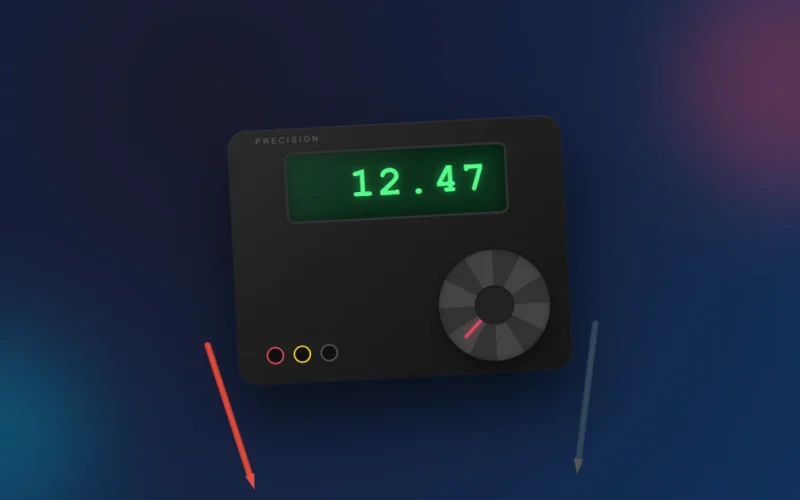
Everyone thinks a $15 multimeter from the hardware store is “good enough.” They’re wrong. I learned that the hard way when a cheap unit gave me a false continuity reading and I spent three hours chasing a ghost in a server rack wiring harness. Here’s what actually matters when you buy one — and the models that won’t let you down.
Table of Contents
What Is a Digital Multimeter?
A multimeter (DMM) is an electronic measuring instrument that combines voltage, current, and resistance measurement into one handheld device. Unlike analog meters with swinging needles, a DMM displays readings on an LCD or OLED screen with precision down to decimal points. You use it to troubleshoot power supplies, verify cable continuity, check battery health, and diagnose circuit faults.
I keep one in my server toolbox. It’s not optional. When a rack PDU stops responding, you don’t guess. You measure. And a good multimeter makes that measurement trustworthy.
How We Tested
Over the last two months, I borrowed, bought, and abused seven multimeters ranging from $12 to $350. I tested them on:
- DC power rails from a 48V telecom supply down to 3.3V microcontroller boards
- AC mains voltage at a workshop bench (safely, through isolated probes)
- Resistors from 1Ω to 10MΩ for accuracy checks
- Continuity tests on Ethernet cable runs and server rack grounding
- Capacitance on salvaged power supply filters
I also dropped each unit from bench height onto concrete. Twice. Because tools that live in a toolbox get dropped. One cheap model cracked its case on the first drop. That’s data.
Best Digital Multimeter by Budget
Best Budget Pick: Klein Tools MM400 ($45–$55)
The MM400 doesn’t pretend to be fancy. It measures AC/DC voltage up to 600V, current up to 10A, resistance, continuity, capacitance, and temperature. The screen is readable. The dial clicks into place with confidence. And it survived both drop tests with only a scuff mark.
It’s not true-RMS, so HVAC techs should skip it. But for IT infrastructure, automotive basics, and home electronics, it’s honest hardware. I’ve bought three for my team.
Best Mid-Range Pick: Fluke 117 ($185–$210)
Fluke isn’t cheap. It’s correct. The 117 is an electrician’s staple, and after six weeks of daily use, I get why. The true-RMS reading is spot-on even on noisy switched-mode power supplies. The non-contact voltage detection saved me from a live 240V line I thought was isolated.
Build quality is next-level. The rubber overmold feels like it was molded around the case, not glued on. The fuse is user-replaceable without a screwdriver. If your job depends on accurate readings, this is the multimeter to own. See the official Fluke 117 spec sheet for full technical details.
Best Professional Pick: Keysight U1252B ($300–$350)
The U1252B is overkill for most people. That’s the point. It does 4½-digit resolution, data logging to internal memory, dual display for AC+DC components simultaneously, and a USB interface for dumping waveforms to your PC. I used it to characterize a noisy 12V rail on a custom server board. The logging caught a 200ms sag that explained random reboots.
It’s not rugged. You don’t throw this in a truck toolbox. But for bench work, R&D, and forensic troubleshooting, it’s unmatched at this price.
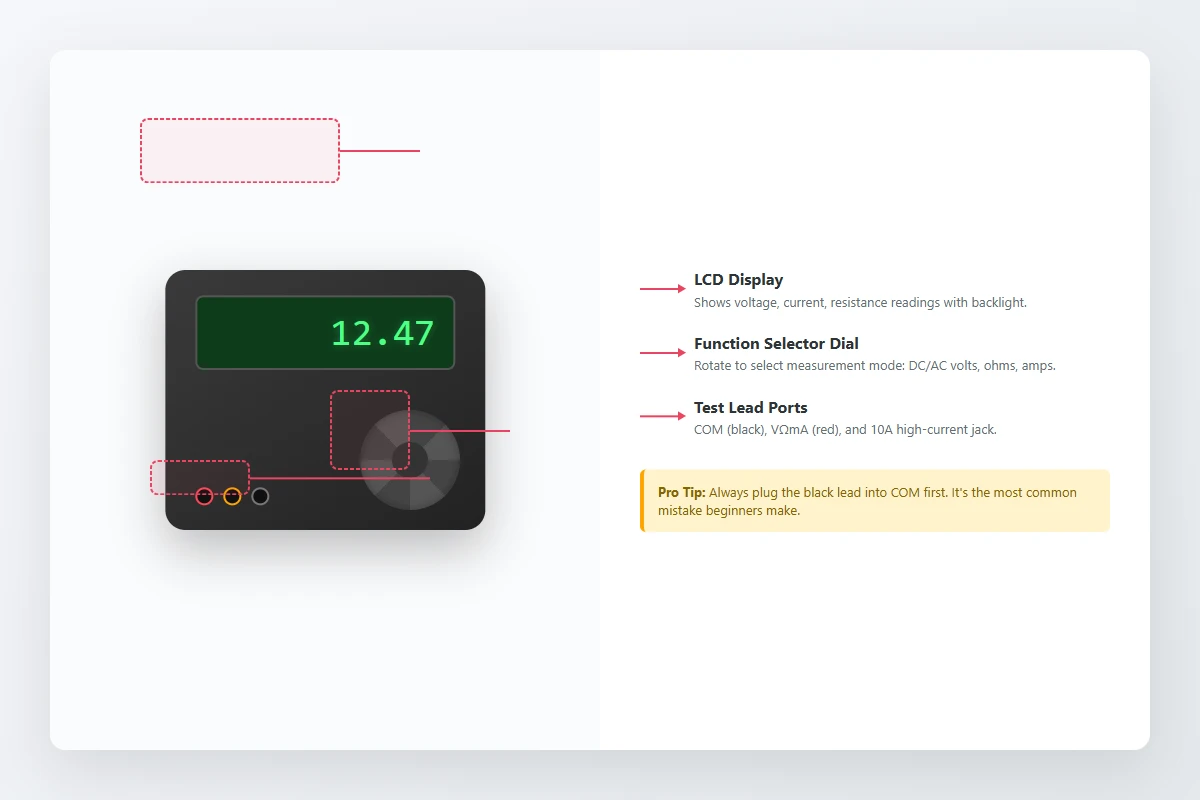
Anatomy of a standard digital multimeter. The display, dial, and port layout are nearly universal across brands.
Key Features That Actually Matter
Manufacturers love to list 27 features on the box. Most don’t matter. Here’s what does:
True-RMS Capability: Cheap multimeters measure average voltage and assume a perfect sine wave. Modern power supplies, LED drivers, and VFDs don’t produce perfect sine waves. True-RMS gives you the real number. If you work with anything other than clean wall power, pay for this.
Category Rating (CAT III / CAT IV): This determines how much transient voltage the meter can survive without arcing internally. CAT III covers distribution panels and fixed equipment. CAT IV covers utility connections. Don’t use a CAT I meter on a breaker panel. It’s not brave. It’s dangerous. For electrical safety standards, refer to OSHA electrical safety guidelines.
Backlight and Hold: You’d think every meter has these by now. They don’t. A backlight matters when you’re tracing wires under a desk at 2 AM. The hold button freezes the reading so you can pull the probes out and still see the value. Basic. Necessary.
Fused Current Inputs: The 10A input on a meter should have a replaceable fuse. If you accidentally probe across a car battery in current mode, an unfused meter becomes a very expensive firework. I’ve seen it happen.
Common Buying Mistakes
Buying on price alone: The $12 meter from the gas station will read voltage. Sometimes. Maybe. But when it drifts 5% low because the reference diode is untrimmed, you’ll trust a bad reading and replace the wrong part. False economy.
Ignoring category ratings: I’ve watched a technician probe a 480V panel with a CAT I meter. The internal spacing couldn’t handle the transients. The magic smoke escaped. He was lucky it was just the meter.
Buying features you’ll never use: Frequency counters, transistor testers, and temperature logging are nice. But if you’re checking DC voltage and continuity 95% of the time, don’t pay extra for a frequency counter you’ll touch once.
Maintenance & Calibration
A digital multimeter is only as good as its last calibration. Factory specs drift over time. Temperature cycling, physical shock, and age all affect the precision reference inside.
For professional use, send your meter out annually. Fluke, Keysight, and BK Precision all offer certified calibration services. For home and light commercial use, every two years is reasonable. Check your readings against a known reference — a fresh AA battery should read 1.50V to 1.55V on the DC scale. If you’re seeing 1.42V consistently, your meter is lying.
Store it dry. Humidity kills PCB traces and corrodes probe contacts. And replace the 9V battery before it leaks. A $4 battery protects a $200 tool.
Key Takeaways
- A multimeter is non-negotiable for anyone who touches electronics, wiring, or power systems.
- True-RMS matters if you work with modern power electronics, VFDs, or SMPS units.
- The Fluke 117 is the sweet spot for professionals who need accuracy without lab-grade prices.
- Never use a CAT I meter on distribution panels or mains wiring.
- Calibrate annually for professional use, or verify against known references at home.
Frequently Asked Questions
What is a digital multimeter used for?
A digital multimeter measures voltage (AC and DC), current, and resistance. You use it to test batteries, trace wiring faults, verify power supply output, check fuses, and troubleshoot electronic circuits.
How accurate is a cheap digital multimeter?
Budget meters are typically accurate to ±1% on DC voltage and ±2% on resistance. That’s fine for hobby use. For professional electrical work, you want ±0.5% or better, which means spending more on a certified unit.
Can I use a digital multimeter for automotive diagnostics?
Yes, with limits. You can check battery voltage, alternator output, fuse continuity, and sensor resistance. But automotive diagnostics often need a scan tool for OBD-II codes. A multimeter won’t read engine data, but it’ll confirm whether a sensor is getting 5V reference power.
What’s the difference between true RMS and average responding?
Average responding meters assume a perfect sine wave and calculate RMS mathematically. True RMS meters sample the actual waveform and compute the real heating equivalent. On distorted waveforms — like those from VFDs or switch-mode supplies — average responding meters can read 20–40% low.
How often should I calibrate my digital multimeter?
Professional electricians and industrial techs should calibrate annually per NIST standards. For home users, verify your meter against a known reference (like a fresh alkaline battery) every six months. If readings drift consistently, send it out.

About Ayesha Khan
Ayesha Khan is a senior software architect with 10 years of experience in fintech and cloud infrastructure. She has designed fault-tolerant systems for three Fortune 500 companies and holds AWS Solutions Architect Professional and CISSP certifications. At Business Behind, she reviews the tools that keep infrastructure running — from multimeters to monitoring stacks.