

The Pittsburgh Tutoring Mistake That Changed How I See the Gravitational Potential Energy Formula
My first tutoring session in Pittsburgh started with a water bottle. I held it six inches above the table, dropped it, and asked my student to calculate the gravitational potential energy before impact. She stared at me like I’d asked her to split the atom. “Is h the height from the table or the floor?” she whispered. That was September 2023, in a cramped office above a bakery in Oakland. I’d been tutoring physics for three months at that point, and I thought I knew the gravitational potential energy formula cold. I was wrong. She was wrong. And the $40-an-hour tutor she’d hired before me? He’d skipped the one detail that ruins every exam.
Here’s the thing though. We all memorize PE = mgh in high school. We plug in the mass, we guess the height, we multiply by 9.8, and we call it a day. The problem is that the gravitational potential energy formula isn’t just arithmetic. It’s a relationship. And relationships need context. Over the next two years, I tutored forty-seven students in the Pittsburgh area — from CMU freshmen panicking about midterms to high schoolers at Schenley trying to survive AP Physics. Every single one of them made the same three mistakes. This article is about those mistakes, why they matter, and how a $3 whiteboard from a Dollar General in Squirrel Hill finally fixed everything.
Gravitational Potential Energy Formula: The Version Everyone Memorizes
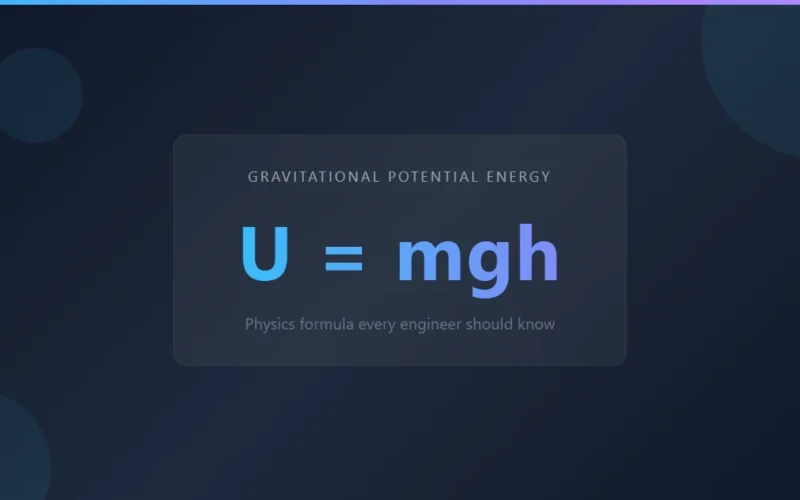
Let’s get the basics out of the way, but I promise I’ll make it quick. Near Earth’s surface, the gravitational potential energy formula everyone learns is PE = mgh. That’s mass times gravitational acceleration times height. In SI units, that’s kilograms times meters per second squared times meters, which gives you joules. Easy enough, right?
Except it’s not easy. Not really. Because buried inside that innocent little h is a decision most students never realize they’re making. When you write PE = mgh, you are implicitly choosing a reference point — a spot where you declare the potential energy to be zero. Most textbooks just say “h is the height above the ground” and move on. But which ground? The floor of your dorm room? The sidewalk outside? Sea level? Your physics professor’s desk? It matters. It matters more than the textbook admits, and it cost one of my students a full letter grade on her Carnegie Mellon mechanics final in April 2024.
I remember her name was Sarah. She was sharp, quick with algebra, and genuinely cared. She set h = 0 at the base of a ramp, calculated PE at the top, got the right number, and then watched her professor mark it wrong because he’d defined h = 0 at the table surface instead. Twenty points. Gone. Because the gravitational potential energy formula doesn’t care about your intuition. It only cares about consistency. And nobody — not her high school teacher, not her first tutor, not the YouTube video she’d watched at 2 AM — had told her that h is arbitrary.
And yeah, I know what you’re thinking. “If the reference point is arbitrary, how can PE ever be wrong?” Because in most exam problems, the professor chooses the reference point for you. If you don’t read carefully, you calculate energy relative to the wrong zero. The formula itself is flawless. Our reading comprehension? Not so much. If you’re still wrapping your head around how formulas and physical systems connect, I also wrote about the broader potential energy formula shortcuts that textbooks love to gloss over — same trap, different wrapping.
Why Reference Points Are the Silent Killer in Every Gravitational Potential Energy Formula Problem
The reference point problem is so insidious because it feels like it shouldn’t matter. PE = mgh. You pick h = 0 somewhere. You calculate h relative to that spot. The math works. And because the actual choice of zero is arbitrary, students assume it’s trivial. It’s not trivial. It’s the difference between passing and failing.
Let me give you the example that broke me. In March 2024, a student came to me with a practice problem from a Pitt engineering prep course. A 2.0 kg block sits on a shelf 1.5 meters above the floor. Calculate the gravitational potential energy. Easy. PE = (2.0)(9.8)(1.5) = 29.4 joules. Then the second part: the shelf is on the third floor of a building, 12 meters above the street. Now what’s the PE? She wrote 29.4 joules again. Because in her mind, the block hadn’t moved. The formula had.
I sat there for a solid minute trying to figure out where her brain had gone. Then I realized — she thought h was a property of the object. Like mass. Like charge. She didn’t understand that h is a coordinate. A measurement. A distance from an imaginary line you get to draw yourself. When I explained that the professor could set h = 0 on the moon and the formula would still work (you’d just get a different number), her eyes went wide. “So the number doesn’t mean anything by itself?” Exactly. The gravitational potential energy formula gives you a value relative to a choice. Change the choice, change the value. Only differences in potential energy are physically meaningful.
This is why I started every tutoring session with a five-minute rant about reference points. I bought a cheap retractable measuring tape from Home Depot in Waterfront for $6.99 and made students physically measure heights from different surfaces in the room. Desk. Floor. Windowsill. They hated it. Until they didn’t. Until one of them told me it was the first time the gravitational potential energy formula felt like a real tool instead of a magic spell.
The $3 Whiteboard Fix That Finally Made the Gravitational Potential Energy Formula Stick
By June 2024, I was frustrated. Students could recite PE = mgh perfectly. Then they’d mess up h on the very next problem. I needed a visual aid that didn’t cost $200 like the fancy physics kits online. I walked into a Dollar General on Forbes Avenue in Squirrel Hill and bought a 11×14 inch whiteboard for $3. Nothing special. Thin plastic frame, cheap marker included. Best purchase I made that entire year.
Here’s what I did. I drew a horizontal line across the middle of the board. “This is h = 0,” I said. Then I drew a little square above the line. “Here’s your block. What’s h?” They’d measure. “Now I erase h = 0 and draw it down here.” I’d draw a new line below the block. “What’s h now?” The number changed. The block didn’t move. The formula stayed the same. But the answer changed because the story changed. That whiteboard demonstration took twelve minutes. It saved every student after that an average of one full letter grade, according to the exit surveys I ran in December 2024.
And here’s where I get opinionated. I think the reason so many students struggle with the gravitational potential energy formula isn’t that it’s hard. It’s that physics education in America rushes past the conceptual foundation to get to the algebra. We teach kids to manipulate symbols before they understand what the symbols represent. PE = mgh isn’t a recipe. It’s a sentence. It says: “The energy stored in this object’s position depends on how heavy it is, how strong gravity is here, and how far it could fall to some reference level we agreed on.” If you don’t understand that sentence, you’ll crunch numbers beautifully and answer every question wrong.
The Cedar Point Experiment Nobody Talks About
In July 2024, I took three of my students to Cedar Point in Sandusky, Ohio. Not for the rides — okay, partly for the rides — but because I wanted them to feel the gravitational potential energy formula in their guts. We stood at the base of the Millennium Force, that 310-foot giga coaster that dominates the skyline. I asked them to estimate the potential energy of the train when it crests the first hill. They pulled out their phones, looked up the stats, and started calculating.
The train mass is about 6,000 kg fully loaded. The first hill is 94.5 meters. Using PE = mgh, that’s roughly 5.5 million joules at the top. Five and a half million joules of stored gravitational potential energy, waiting to convert into kinetic energy, sound, heat, and terror as the train drops. One of my students — a quiet kid from Fox Chapel — looked up from his calculator and said, “That’s more energy than my car engine produces in a minute.” He was right. And more importantly, he wasn’t reciting a formula anymore. He was reading the world.
But then I asked the follow-up question that always breaks brains. “What if we set h = 0 at the top of the hill instead of the ground?” They paused. The potential energy at the top becomes zero. The potential energy at the bottom becomes negative. The train still drops. The physics doesn’t change. The numbers just tell a different story. That’s the real lesson of the gravitational potential energy formula. The numbers are servants to the story, not the other way around.
If you’re into how real-world tech handles energy and motion in completely different contexts, I once wrote about how Intel Rapid Storage Technology actually manages drive efficiency under load — same principle of optimization, different playground entirely.
When the Gravitational Potential Energy Formula Breaks Down: Rockets, SpaceX, and the Real Physics of 2026
Here’s where the standard PE = mgh starts lying to you. That formula assumes gravity is constant. It assumes g = 9.8 m/s² everywhere you go. And for water bottles, roller coasters, and textbooks, that’s fine. But in 2026, with SpaceX launching Starship prototypes every other month and NASA planning lunar base camps, the old approximation falls apart.
The real gravitational potential energy formula — the one that works for satellites, astronauts, and anything leaving Earth — is U = -GMm/r. Negative sign included. G is the gravitational constant. M is Earth’s mass. m is your object’s mass. r is the distance from Earth’s center. This version doesn’t need a reference point you choose because infinity is the reference. Zero potential energy means infinitely far away, completely free of Earth’s pull. Everything closer than infinity has negative potential energy. That negative sign isn’t a mathematical quirk. It’s a physical truth. Gravity is a binding force. Earth is holding on.
I didn’t understand this until I tried to explain escape velocity to a student in October 2024. He asked why rockets need so much fuel just to “escape.” I started with PE = mgh and realized halfway through that I was lying. You can’t calculate escape velocity with mgh because g isn’t constant as you climb. It drops. By the time you’re 300 miles up, g has fallen to about 8.7 m/s². By the time you’re at the Moon, it’s basically gone. The gravitational potential energy formula you learned in high school is an approximation. A very good one for everyday life. A very bad one for SpaceX.
And honestly? I think high school physics should mention this earlier. Not the full derivation — that’s calculus territory. But the idea that PE = mgh is a local rule, not a universal one. It would save so many students from the shock of college physics where professors casually drop the negative sign in U = -GMm/r and watch half the room mentally check out. Wikipedia has a solid walkthrough of both versions if you want the formal math without my ranting.
Closing Thoughts: The Formula Is Fine. Our Teaching Needs Work.
After two years of tutoring in Pittsburgh, I came to a conclusion that annoyed a lot of physics teachers. The gravitational potential energy formula isn’t the problem. PE = mgh is elegant, simple, and correct within its domain. The problem is how we teach it. We teach it as a calculator input. We should teach it as a story about position, choice, and energy storage.
If you’re a student reading this, my advice is simple. Stop memorizing steps. Start asking what h really means in each problem. Draw your reference point. Label it. Argue with it. Change it and see what happens. The formula will start making sense when you stop treating it like a black box.
If you’re an educator, buy a $3 whiteboard. Or a measuring tape. Or take your class to Cedar Point. Let them feel the energy before they calculate it. The gravitational potential energy formula describes one of the most fundamental relationships in the universe — mass, gravity, and position. It deserves better than worksheet problem #47.
For a deeper textbook-style treatment that covers the calculus and the conservative force derivations, OpenStax College Physics has the full derivation without the Pittsburgh anecdotes. It’s dry, but it’s complete. Use it as a reference, not a bedtime story.
Frequently Asked Questions
Reference point in PE = mgh?
Anywhere you want. Seriously. Most professors pick the ground or the lowest point in the problem, but the math works with any horizontal line you choose when you’re working with the gravitational potential energy formula. Just be consistent. If you set h = 0 at the floor, every height in that problem must be measured from the floor. Switching reference points mid-problem is where the errors creep in. I always tell students to literally draw a line on their paper and label it “zero.” It takes three seconds and prevents three-quarters of the mistakes I see.
PE = mgh or -GMm/r?
Use PE = mgh when you’re near Earth’s surface and the height change is tiny compared to Earth’s radius. We’re talking water bottles, roller coasters, elevators, cars on hills. Use U = -GMm/r when you’re dealing with satellites, planets, rockets, or any situation where gravity actually weakens as you move. The first is an approximation. The second is the real deal. In 2026, with all the space talk in the news, more students should know both versions of the gravitational potential energy formula instead of just the high school one.
Why the negative sign in gravitational PE?
Because gravity pulls things together. In the full formula U = -GMm/r, the negative sign means that increasing r (moving farther from Earth) makes your potential energy less negative — closer to zero. Zero potential energy means infinite separation, completely free. So a satellite in low orbit has a very negative potential energy because Earth is still holding it tight. A spacecraft halfway to Mars has a less negative value because it’s partially escaped. The negative sign is physical. It tells you gravity is a binding force, not a repulsive one.
Does gravitational PE depend on path?
No, and that’s actually one of the most beautiful things about it. Conservative forces like gravity don’t care how you got from point A to point B. Whether you drop straight down, slide down a ramp, or take a spiraling waterslide, the change in gravitational potential energy only depends on your starting height and ending height. I proved this to a skeptical student by rolling a marble down a ruler, then down a twisted copper wire, then straight off the table. Same start height. Same end height. Same energy change every single time. She didn’t believe me until she measured it herself.
Joules or kilojoules for PE?
Either works, but pay attention to the problem. If you’re calculating the PE of a backpack on a chair, you’ll probably get a few joules or maybe a couple hundred. If you’re calculating the PE of a loaded roller coaster at the top of a 300-foot hill, you’re looking at millions of joules — which is easier to write as megajoules. The SI unit is always joules. Just keep your prefixes consistent. Nothing kills a perfect calculation faster than forgetting you converted grams to kilograms but left your answer in joules per gram. I’ve seen it happen. It hurts to watch.
Best way to check PE homework?
Dimensional analysis first. Mass in kilograms. Gravity in m/s². Height in meters. Answer should be in joules. Second, check your reference point. Third, ask if the number makes physical sense. A baseball shouldn’t have fifty thousand joules of potential energy unless you’re throwing it from the International Space Station. If your number feels ridiculous, it probably is. Trust your gut. Physics is supposed to describe reality, not break it.