

Most gardeners pull up a grow a garden calculator expecting a simple answer: plant this, harvest that. But here is the thing the numbers those tools spit out are only as good as the inputs you give them, and most people are filling in the wrong ones. If your garden consistently underperforms despite following every suggested spacing and schedule, the calculator is not broken. Your data is.
This piece breaks down what those calculators are really measuring secret weapon as grow a garden calculator where the logic falls apart, and how you can use them to actually build a productive growing plan rather than just a tidy spreadsheet that looks good until the first frost.
The Hidden Variables Most Calculators Ignore
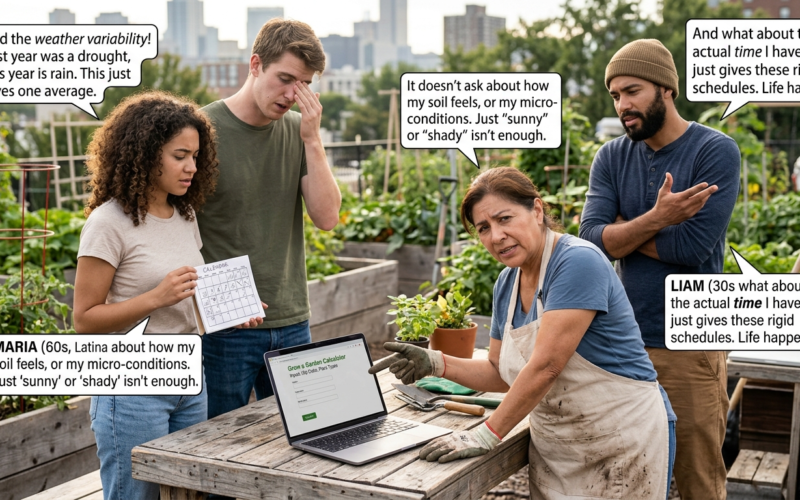
Every grow a garden calculator operates on baseline assumptions. Sun hours, zone averages, generic soil type. They are designed for the median gardener in the median climate on a median plot of land of grow a garden calculator. The problem is that no gardener is median.
Microclimates and Why They Shatter Zone Logic
Your USDA hardiness zone is a macro-level guide. It tells you roughly when your last frost arrives and how cold your winters get. What it does not tell you is that the corner of your yard behind the brick wall runs 4 to 6 degrees warmer than the open center bed, or that the low-lying patch near your fence collects cold air and frosts two weeks after everywhere else has moved on.
Before you trust any calculator output, spend one season mapping your actual microclimate grow a garden calculator. A cheap outdoor thermometer with a remote sensor moved around your beds over several weeks will reveal patterns that no zone chart can predict. Once you have those readings, you can feed far more accurate data into any planning tool.
Soil Biology vs. Soil Chemistry
Calculators love asking for your soil pH and NPK levels because those are measurable numbers. What they cannot account for is the biological activity in your soil the microbial populations, mycorrhizal networks, and earthworm density that determine how available those nutrients actually are to your plants.
A garden with perfect chemistry but dead biology will produce consistently disappointing results regardless of what any calculator recommends. If you are using a planning tool to decide on fertilizer quantities or planting density, pair it with an annual soil biology assessment, not just a standard chemistry test.
Rethinking How You Feed Numbers Into the Tool
The output of any calculator is shaped entirely by the quality of your inputs. Here is what most gardeners overlook when filling in the fields.
Succession Timing Is Not Linear
Many gardeners use calculators to plan succession planting staggering crops so you get continuous harvests rather than one overwhelming glut. The mistake is assuming equal intervals. A second sowing of lettuce two weeks after the first makes sense in spring. In midsummer, that same two-week gap means the second batch germinates into brutal heat, and you get nothing.
Succession timing should be based on temperature windows, not calendar spacing. When you use a calculator, adjust your intervals based on projected heat accumulation, not just weeks on a calendar. Many modern tools have a growing degree day function — use it.
Container Volume and Root Depth Are Different Numbers
If you grow in containers or raised beds, this distinction matters enormously. A 15-gallon container might look generous on paper, but if your tomato variety requires 18 inches of root depth and your bed is only 12 inches deep, the volume is irrelevant. Always input root depth requirements alongside container volume when planning intensive plantings.
Where Calculators Actually Excel?
Despite their limitations, grow a garden calculator tools genuinely shine in several areas that most gardeners underuse.
- Calorie and yield planning for food sovereignty goals calculating how many square feet of potatoes or beans you need to sustain a household for a season
- Spacing optimization for small-space intensive methods like square foot or biointensive growing
- Seed quantity estimation to reduce waste and over-purchasing before each season
- Crop rotation planning across multiple beds and multiple years when you feed it historical planting data
The Compounding Effect of Small Inaccuracies
When Being Off by 10% Costs You Half Your Harvest?
Garden planning involves layers of variables stacked on top of each other. A 10% error in your estimated sun hours combines with a 10% error in soil moisture retention, which compounds with a 10% miscalculation in plant spacing. By harvest time, those small individual errors can produce a 40 to 50% gap between projected and actual yield.
This is not a reason to abandon grow a garden calculator. It is a reason to build in intentional margins. When a tool tells you to plant 18 inches apart, consider planting a test row at 16 and another at 20 to observe which performs better in your specific conditions. Use the calculator as a starting hypothesis, not a final answer.
Combining Calculator Data With Observation Logs
The most productive gardeners are the ones who treat their space as a long-running experiment rather than a one-time project. A calculator gives you a plan. Your observation log gives you calibration data to make every future plan more accurate.
Track germination rates, days to first harvest, yield weights per plant, and how each variety performs under your specific conditions. Feed those numbers back into your calculator inputs the following season. Over three to five years, grow a garden calculator for you will have a personalized dataset that makes generic zone-based tools dramatically more useful.
Apps Worth Stacking With Your Calculator
A standalone calculator works better when paired with a garden journaling app that logs actual outcomes, a weather station app that records your specific precipitation and temperature data, and a soil moisture sensor that feeds real-time readings rather than estimated values. The goal is to shrink the gap between the generic assumptions baked into planning tools and the specific reality of your garden.
A Note on Companion Planting and Polyculture Calculations
Most grow a garden calculator platforms are designed around monoculture rows one crop per bed, one spacing recommendation per plant. If you grow using companion planting or polyculture systems grow a garden calculator, the numbers break down almost completely. A tomato calculator will not account for the nitrogen fixed by beans growing alongside it, or the pest suppression contributed by nearby basil.
For polyculture systems, use the calculator to establish base requirements for each individual crop, then reduce inputs proportionally based on companion benefits you have documented grow a garden calculator in your own garden. Do not expect any tool to do that math for you automatically. The relationships between plants are still too complex and site-specific to be reliably modeled.
Getting Honest Results From Any Planning Tool
The gardeners who get the most out of a grow a garden calculator are not necessarily the ones with the most technical knowledge. They are the ones who are brutally honest about what they actually observe rather than what they hope is happening. Plugging in your real sun hours — even if they are disappointingly low grow a garden calculator will produce a plan you can actually execute. Plugging in ideal numbers will produce a plan that looks great on a screen and fails in the ground.
Track, measure, observe, and update. That cycle of honest feedback is what transforms a generic planning tool into something that actually works for your specific patch of ground.
For deeper insight into yield modeling and soil health metrics that improve calculator accuracy, the research published by University of California Agriculture and Natural Resources offers science-backed frameworks that home gardeners can apply directly to their planning process.
FAQs
How accurate is a grow a garden calculator for first-time gardeners?
For beginners, accuracy is typically moderate. The tool gives a solid starting framework, but real accuracy improves season by season as you replace generic input values with data from your own observed conditions.
Can I use a grow a garden calculator for container gardening?
Yes, but you need to input root depth requirements separately from container volume. Many tools only ask for volume, which can lead to poor plant selection for shallow containers. Always cross-check root depth specs for each variety.
Why does my actual yield differ so much from the calculator estimate?
Small input errors across multiple variables compound quickly. Inaccurate sun hours, soil drainage assumptions, and spacing estimates each introduce small errors that stack into a large gap between projected and real output.
Should I use multiple calculators or just one?
Using two or three tools and comparing outputs is a smart approach. Where they agree, you can be more confident. Where they diverge significantly, dig into why — it usually points to a variable worth investigating more carefully in your own garden.