
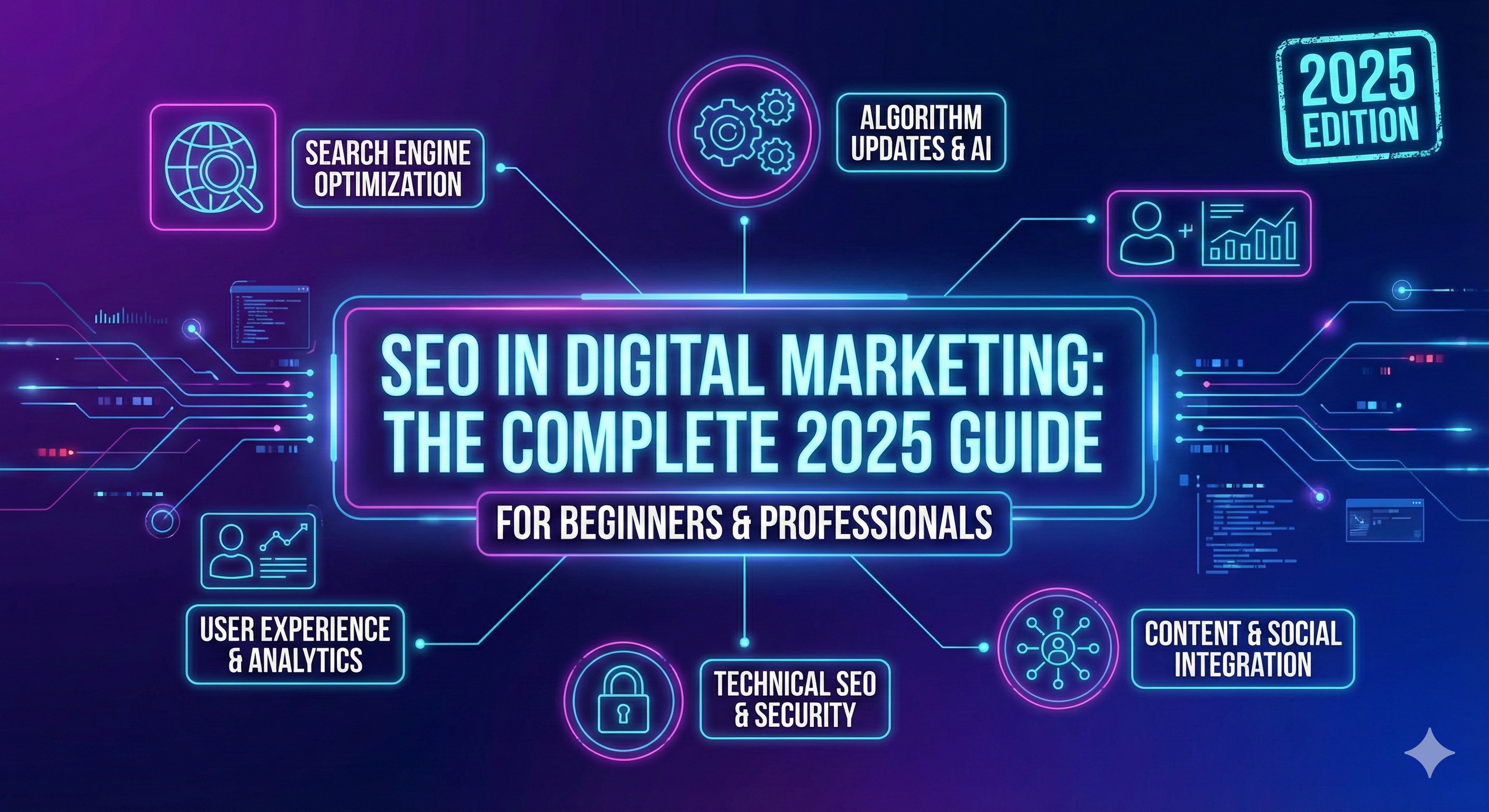
What is SEO in digital marketing? In the modern digital world, each big or small business needs a strong online presence. But just creating a website is not enough; you need a strategy that brings targeted traffic, builds trust, and thus increases sales. This is where the question “What Is SEO in Digital Marketing?” becomes utmost important. Search Engine Optimization, or SEO, is one of the most powerful digital marketing techniques that helps websites appear on top of search engines like Google, Bing, and Yahoo. When your website ranks higher, more people discover your business, click your content, and become customers.
Before getting into the advanced ways of marketing, one must know what SEO is, how it works, and why it is one of the most valued long-term approaches for online growth. How does SEO work? This article goes through all you need to know about SEO in digital marketing, and in a clear, professional human-friendly way. Each paragraph is crafted to be five to six lines for easy reading, yet keeping SEO quality intact.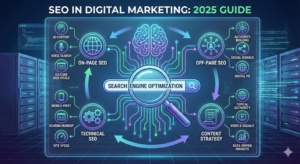
What Is SEO in Digital Marketing? – Definition Explained
SEO stands for Search Engine Optimization and is a digital marketing initiative undertaken to enhance the visibility, ranking, and performance of a website on search engines. Whenever people browse through products, services, or information, SEO helps your website top the list of search results. The higher the ranking of your website, the greater the organic traffic that results without the need to pay for advertisements. Quite simply, SEO helps a business show up exactly where potential customers are searching.
Think of Google, for example, as a gigantic library with billions of pages. SEO makes your site shine, locates it under the proper categorization, and suggests it to the readers when those readers are looking for something that should be on your website. SEO encompasses techniques such as keyword optimization, creation of high-quality content, link-building, improvement in website speed, and mobile-friendly design. All these factors combined help the search engine crawlers understand your website to reward it with higher rankings.
Why SEO Is Important in Digital Marketing in 2025?
SEO is at the core of digital marketing strategies because it leads to organic traffic, good brand visibility, and profitability of business on the whole. Unlike paid advertisements, which often stop running the moment your spending does, SEO will continue bringing traffic well after you’ve stopped investing in it, and that’s what makes it one of the most cost-effective marketing strategies. To businesses competing online, SEO is no longer optional but an absolute necessity for success amidst an increasingly crowded marketplace.
This is 2025, and the competition has been doubled online. And also, people prefer searching over Google before trusting any brand. They read the reviews, compare products, and check the online visibility of products before making a buying decision. If your business is not visible online, you instantly lose to competitors. That is why SEO is necessary to build up authority, stand out online, and attract people who are already interested in what you offer.
SEO Helps You Rank Higher and Gain Visibility
The main objective of SEO in digital marketing is to assist your website in ranking on the first page of Google. Very few users navigate past the first page; hence, the top-ranking websites gain the majority of clicks. When your website appears in the top results, people automatically build more trust in your brand. Ranking higher gives you credibility and positions your business as an expert in your industry, making it easier to naturally attract customers.
SEO Provides a Steady Stream of Free Organic Traffic
Another strong point of SEO is that it yields long-term, sustainable traffic without requiring continuous investment. Paid advertisements will cease to generate leads the moment the budget runs out, whereas SEO just keeps working 24/7. Based on your ranking for valuable content, your website receives automatic visitors each day. That’s what makes SEO a great investment, bringing in results for months and even years with no additional cost.
SEO Improves User Trust, Experience, and Brand Authority
Users believe in Google’s recommendations. If the website appears on top of the search, people consider it reliable and worth visiting. SEO builds a website that is quick, secure, mobile-friendly, and user-centered-all of these improve user experience. Search engines love websites that add value, solve problems, and serve up smooth browsing for users. The better your user experience, the more trust your website earns to build lasting brand authority.
Types of SEO in Digital Marketing- Complete Breakdown
Understanding the different types of SEO in digital marketing is necessary because each type focuses on one unique area of optimization. These together work on improving visibility, rankings, and user experience. Any business that wonders “What Is SEO in Digital Marketing?” needs to learn about these types also, since SEO itself is not a technique but multiple strategies combined. Below, major types of SEO you must know to fully optimize your website in 2025 are mentioned.
On-page SEO through Digital Marketing in Content & Keywords
On-page SEO deals with what happens within your website. It includes optimization of content, keyword placement, HTML tags, headings, and internal linking. If someone searches for a term, say, “What Is SEO in Digital Marketing?”, Google goes through your content to see relevance, clarity, and if keywords are placed well. If your page is set up well, your chances go up way higher. 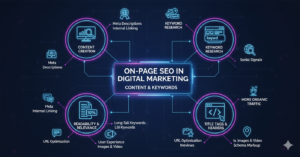
On-Page SEO is important in establishing what a page is all about to the search engines. When your content is properly structured and user-friendly, Google pays with high rankings. If there is no proper On-Page SEO, even quality content cannot reach the proper audience.
Key Elements of On-Page SEO
Following are some of the most important On-Page SEO ranking factors:
Strategic keyword placement
SEO-friendly titles and meta descriptions
Proper use of H1, H2, H3 headings
Internal linking structure
Optimised images (ALT tags)
Clean and readable URL structure
High quality, informative content
These elements help search engines connect your page with appropriate search intent and help improve organic visibility.
Off-page SEO in Digital Marketing (Building Authority)
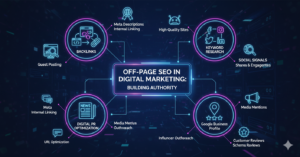
Off-page SEO consists of methods that one adopts outside of their website. This helps in increasing the reputation and authority of the website. The aim of Off-page SEO is to establish the websites trust factor in the eyes of search engines through mentions, citations, and most especially high-quality backlinks. If quality authoritative websites link to your content, Google sees it as a vote of confidence.
Many people think SEO is purely about keywords, but Off-Page SEO proved that reputation can be just as important as content. A website with strong backlinks tends to rank higher because search engines look at that website as credible and trustworthy. For this reason, Off-Page SEO provides an important piece in the puzzle of learning what SEO is in digital marketing.
Key Off-Page SEO Techniques
The most powerful off-page SEO techniques are the following:
Guest blogging on relevant sites
Building quality backlinks
Social media engagement and signals
Brand mentions and citations
Influencer collaborations
Participation in forums and community activity
The more authority your website builds, the easier it becomes to rank for competitive keywords.
Technical SEO in Digital Marketing-Performance and Crawling
Technical SEO optimizes the back-end structure of your website to allow search engines to crawl, understand, and index it more effectively. If you don’t have any Technical SEO, then even great content or backlinks will fail to make your website rank strongly. That your website loads fast, remains secure, and gives an extraordinary user experience.
In 2025, Google leans heavily towards performance metrics like Core Web Vitals, which include page loading speed, visual stability, and interactivity. Companies with poor Technical SEO might struggle hard to rank and often can’t even retain users.
Key Technical SEO Elements
Some of the most important ranking factors in Technical SEO include:
Fast loading of pages
Mobile-friendly responsive design
Establish a secure HTTPS connection.
Proper XML sitemap
Proper robots.txt file configuration
Clean website architecture
No broken links or errors
The technically optimized website lets Google understand your content better and rewards you with higher rankings.
Local SEO in Digital Marketing: For Local Businesses
Local SEO will be important for businesses that target customers within a certain geographic area. Whenever people search for restaurants or the best dentist in Karachi, Google will show the local results first. That is where Local SEO plays a major role. It helps your business appear in Google Maps, Local Pack, and in local searches.
Local SEO matters because people trust local businesses that show up in the top three map results. If your business isn’t optimized for a local search, you lose valuable customers to competitors that show up above you. Understanding what SEO is in digital marketing means also understanding how to reach your local audience effectively.
Key Local SEO Ranking Factors
The optimization steps involved with Local SEO include:
Setup and Optimization of Google Business Profile
Building local citations in directories
Using local keywords like “near me”, city names, area names
Get customer reviews
Ensuring NAP consistency: Name, Address, Phone number
These elements help your business stand out in local search results and drive more walk-in and online customers to your business.
E-Commerce SEO in Digital Marketing:
For Online Stores SEO E-Commerce focuses on product page optimization, category pages, and structure of the site. Since online shopping in 2025 is developing extremely fast, SEO in e-commerce has become not a need but a must. People go online to review products, compare them, and find tutorials, after which they make a purchase. If your shop does not appear in these searches, you immediately lose potential buyers. Understanding what SEO is in digital marketing becomes even more important when running an online store. E-Commerce SEO helps in increasing sales, reducing cart abandonment, and building long-term customer trust. It ensures your products rank atop of the competitors and attract high-intent shoppers.
How Does SEO Work in Digital Marketing?
Knowing how search engines work is important for a full understanding of what SEO is in digital marketing. SEO works through a combination of technical optimization, content strategy, and authority building. Search engines use advanced algorithms to analyze websites and decide which pages deserve the top positions. When your website aligns with Google’s ranking factors, you earn higher visibility and attract organic traffic.
SEO works on three major processes: crawling, indexing, and ranking. These steps determine the appearance of your website in search results and the ranking order. If any of these parts of this process are weak, then your website might remain invisible to the search engines. This is the reason why understanding the working mechanism has become quite crucial for every long-term SEO digital marketer.
Crawling: How Search Engines Discover Your Website
Crawling basically means the first stage of SEO. Search engines use some bots, which are also called crawlers or spiders. They scan websites for information. These bots go through every page, read through the content, images, links, and structure, and understand what your website is. When your website becomes easy to crawl, then search engines discover your pages much faster and in more efficient ways.
Poor crawling happens when sites are slow, blocked by the robots.txt file, or links on them are broken. That somehow stops Google bots from reaching major pages, thus hurting rankings. That is why Technical SEO is closely connected with the process of crawling. The easier your site is to crawl, the better your chances are for ranking on competitive keywords like “what is SEO in digital marketing”.
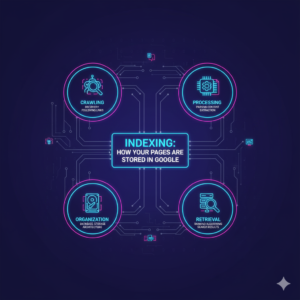
Indexing: How Your Pages Are Stored in Google
Once the search engines have crawled your website, they store the data in the index. Indexing is like adding your website to a digital library where users can find it later. If your website is not indexed, it simply does not exist in search results. Many new websites face indexing issues because of poor website structure or thin content
.
You should have a clean sitemap, no errors on pages, and good internal linking to help Google index your website properly. Such elements will help the search engine get a better understanding of how important your content is and why it’s relevant. When you publish a new article explaining what SEO is in digital marketing, correct indexing will make people find it when searching for related topics.
Ranking – How Google decides which page comes first
Ranking is the ultimate and most fundamental step in SEO. Once crawling and indexing occur, Google takes your page and compares it to millions of other pages to find out where it should rank in search results. Over 200 algorithms have an impact on ranking, with a focus on relevance, quality, authority, and user experience.
This is where the real worth of SEO kicks in. If your content is excellent, your keywords highly relevant, your site loads fast, and your domain has good authority, Google ranks your page higher. That is how websites get to the first page, drive traffic, and amass long-term success. For competitive terms, such as what is SEO in digital marketing, ranking depends on how well your page satisfies search intent and provides real value.
What are the major ranking factors in SEO?
For a higher ranking in 2025, it is crucial to understand what the most important ranking factors Google uses are. These factors will make all the difference in whether your website makes it to page one or gets buried beneath the competition. Those businesses that understand these ranking signals are able to craft more effective digital marketing strategies and enjoy long-term visibility.
These ranking factors include on-page optimization, technical performance, backlinks, mobile experience, content quality, and user engagement. Each of these components interacts in various ways to improve the view search engines take of your website. The key ranking factors that you should focus on are listed below.
Content Quality and Search Intent.
The core of SEO is all about content. Google will rank those pages that promote precise, useful, and informative content. It’s like when users search for a term, such as “what is SEO in digital marketing”; Google would want to present them with the best explanation possible. That means your content should answer their questions, solve their problems, and provide clarity in a human-friendly way.
Search intent is the reason behind a user’s search. If your content aligns with user intent, chances of its ranking shoot up noticeably. Google will always want to show the most relevant and satisfying results. Quality content, written for humans and not just algorithms, provides better engagement and gains better ranking.
Keyword Optimization and Relevance
Keywords are what enable Google to understand the theme of your content. Keywords should be rightly placed in titles, headings, meta descriptions, and inside the content. However, keyword stuffing hurts the rankings since it makes the content unnatural. It is important to use keywords both naturally and strategically.
For example, if your page is about what SEO is in digital marketing, this keyword should appear in
Title
Introduction
One or more H2/H3 headings
A number of body paragraphs
The conclusion
These indications, when viewed by search engines, show that they clearly perceive the topic and rank your page.
H3- High-Quality Backlinks and Domain Authority Backlinks are one of the most powerful ranking signals. When quality websites link to your content, it acts as an indicator to Google that your website is reliable and full of value. This will gain you higher domain authority and increase your probability of ranking for competitive search terms. However, not all backlinks are equal, and high-quality and relevant links are bound to be more powerful compared to random or spammy links. Guest posting, digital PR, content marketing, and outreach campaigns work as the best ways to earn strong links. A page will always outperform others that explains what SEO is in digital marketing if it has more authoritative and relevant links.
Most Effective SEO Strategies in Digital Marketing for 2025

To get a complete understanding of what SEO is in digital marketing, you have to understand several strategies that help SEO work. This 2025 has seen new ranking factors, AI-driven updates, and user-experience standards that further push SEO ahead. With this, businesses can no longer use outdated methods, as they are compelled to adopt modern techniques to keep up with the evolving algorithms. Here are the most effective SEO strategies that ensure guaranteed long-term results.
Advanced Keyword Research and User Intent Analysis
Keyword research is the foundation of SEO, but it’s not just about finding high-volume keywords in 2025; it’s about understanding user intent-what people actually want when they search. When users type “what is SEO in digital marketing,” they expect a clear explanation with examples and benefits. Your content must deliver precisely what they are looking for.
Modern keyword research tools identify long-tail keywords, search patterns, frequently asked questions, and competitor gaps. You will then combine these insights to build content that answers user questions no one else can. If your page satisfies search intent, Google favors it in rankings.
High-Quality, Humanized, SEO-Optimized Content Creation
Content remains the most important part of SEO. Search engines give priority to content that is informative, well-structured, easy to read, and genuinely helpful. Fast-forwarding to 2025, AI-generated content is everywhere, but humanized content is what makes them stand out. That means writing in a natural, conversational, and valuable tone-just like this article.
When creating content, especially on what SEO is in digital marketing, one must not forget to include
Well-researched insights
Examples and explanations
Keyword-optimized headings
Smooth transitions
Actionable steps
Top-rated content increases user engagement, decreases bounce rate, and positively affects overall SEO performance.
Building High Authority Backlinks Through Outreach
The backlinks remain one of the strongest ranking factors. However, today Google strongly emphasizes quality over quantity: a few links from trusted, relevant websites are much more worthy than hundreds of links of low quality. That is why modern SEO includes strategic outreach, guest posting, and relationship-building with reputable websites.
Meanwhile, an article about what SEO is in digital marketing, which has been well-optimized, will have a far better chance of ranking when, indeed, it gains backlinks from blogs on digital marketing, other industry publications, and authority sites. These links act as endorsements, showing Google that your page is a trusted source and deserves some visibility.
Enhancing Mobile Experience & Website Speed
With over 70% of users searching on mobile in the year 2025, Google applies mobile-first indexing. Your website’s mobile version is now more important than that of its desktop version. Slow or poorly designed mobile websites lose customers and rankings too. Page speed, responsiveness, and visual stability are critical for search engine optimization success.
Google’s Core Web Vitals-Largest Contentful Paint (LCP), First Input Delay (FID), and Cumulative Layout Shift (CLS-play a major role here. When your site loads fast and provides a seamless user experience, automatically your SEO rankings increase.
Optimize Technical SEO for Crawling and Indexing
Technical SEO will make sure search engines can access, crawl, and index your website as easily as possible. And, quite frankly, it’s nearly impossible for a website without strong technical foundations to rank well in search engines. Not even the best content about what SEO is in digital marketing will be able to perform, if there are crawling errors, broken links, or slow pages on your site.
Key technical enhancements include:
Creating XML sitemaps
404 error fixes
Using HTTPS
Improving site architecture
Schema markup optimization
Keeping the URLs clean
These actions help search engines to understand your website better and enable better consistency in ranking.
SEO Benefits in Digital Marketing
Understanding what SEO is in digital marketing also helps understand its benefits. It provides long-term value no other marketing strategy can provide. It helps businesses grow organically, attract the right audience, and improve profitability without depending on paid advertisements.
Below are the biggest advantages of SEO in today’s digital age.
H3 – SEO Drives Quality Organic Traffic
Organic traffic is defined as individuals who will visit your website through the use of search browsers without paid advertising. It is very valued, since users are proactive in their searches for information, products, or services. If your content positions well, you will attract people who already need what you have to offer.
For instance, when a person searches for what is SEO in digital marketing, they are already interested in learning about SEO. If your content is at the top, they visit your page and probably explore your services or products afterward.
SEO Builds Long-Term Brand Visibility and Authority
SEO will help you consistently show up in search engines, building a strong brand recognition. Every time internet users see your website ranking for related keywords, they start to trust the brand. This trust translates into long-term authority that can help your website tackle even the saturated markets.
They are viewed as industry leaders when brands publish high-value content regularly, gain backlinks, and maintain strong SEO signals. This authority converts into more traffic, more customers, and ultimately, more opportunities for growth.
SEO Reduces Marketing Costs and Increases ROI
Paid ads work well but are quite costly. The moment you stop paying, the traffic is gone. At the same time, SEO keeps on driving traffic even after the work of optimization is complete. This makes SEO one of the most cost-efficient marketing strategies with the highest return on investment.
A single well-optimized page, explaining what SEO is in digital marketing, can attract thousands of visitors every month with no ongoing advertising cost. It is this long-term value that makes SEO so essential to sustainable business growth.
SEO Improves User Experience and Engagement
Google favors websites that offer the best user experience. When your website is fast and mobile-friendly, users are able to stay longer and explore through many pages. Engaging more with your content also increases the conversions-very much valuable for business growth. Better user experience = better rankings = more conversions.
Real-World Examples of What SEO Is in Digital Marketing
Real-life examples will help demystify what SEO is in digital marketing. Such examples, actually, will also show how businesses grow, attract customers, or outcompete competitors with its help. Whether you run a service business, an e-commerce store, or blog, SEO can turn around your entire online presence and significantly increase your revenue from any level.
Businesses today rely on organic search for lead generation, as users prefer finding solutions naturally rather than clicking ads. When a website ranks at the top, people develop trust and a sense of confidence in the brand. Below are some simple yet powerful examples that show how SEO works in different industries in 2025.
Example 1: Local Restaurant Using Local SEO
Think of a user looking for “best pizza near me” or “pizza restaurant in Lahore.”
If your restaurant has strong Local SEO—optimized Google Business Profile, positive reviews, proper keywords, and local citations—it will appear in the Top 3 Map Pack. This placement gives your business maximum visibility and greatly increases orders and foot traffic.
That’s the power of SEO in digital marketing: without running ads, your business can win customers just by ranking higher for relevant searches. Local SEO will be more helpful for restaurants, salons, clinics, gyms, and service providers.
Example 2: Service-Based Business Ranking for “Near Me” Searches
SEO is greatly beneficial for service providers, including plumbers, electricians, and home services. Whenever someone searches for “best plumber near me” or “emergency electrician Karachi”, most people select a business from the top three results. SEO helps service providers rank for such high-intent keywords.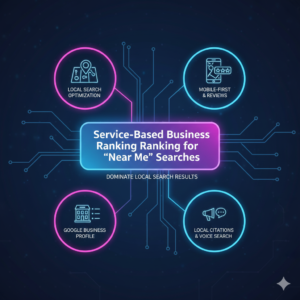
If your business shows up as one of the top results, you get more calls, leads, and clients. That’s why service-based businesses depend on SEO so heavily to build trust and grow their businesses consistently.
Example 3: Blogger Driving Traffic with Content SEO
A blogging website can generate thousands of monthly visitors by ranking for informational keywords. For instance, if your blog ranks for “what is SEO in digital marketing,” you attract readers that want to learn SEO. These visitors can later click ads, buy products, or join your email list.
SEO helps bloggers build authority and provides a stable source of income through ad monetization, affiliate marketing, and sponsored posts. With the proper SEO strategy, even the newest blogs can compete with big websites.
Example 4: E-Commerce Store Ranking for Product Keywords
SEO is used by online stores selling electronics, clothing, or beauty products to rank for product-based searches. Typically, people search for items such as “best gaming laptop 2025” or “top skincare products for oily skin.” That is where well-ranking product pages and category pages attract buyers who are ready to buy.
Strong SEO helps e-commerce stores reduce their dependence on paid advertisements and achieve long-term sales growth. SEO-optimized listings, product descriptions, and reviews build trust and drive conversions.
Conclusion:
What Is SEO in Digital Marketing? SEO is a strategic, organic, long-term methodology to enhance the visibility, traffic, trust, and customer growth of a website from search engines. It helps your business reach the right audience at the most decisive time without ever paying for ads. SEO will establish your brand as an industry leader through keyword optimization, high-quality content, backlinks, technical improvements, and enhancements in user experience.
In 2025, SEO is no longer a maybe; it’s a must. The business owner, freelancer, blogger, and marketer who understands SEO has the competitive edge. And with regular effort, quality content, and the proper strategies in place, SEO can continue driving traffic, leads, and sales for years to come, without additional cost.
SEO is the most robust digital marketing investment one can have, offering a comprehensive package of long-term growth, stronger brand authority, better user engagement, and continuous organic traffic.
FAQs
What is SEO in digital marketing in simple words?
SEO, by definition, means improving your website so it appears higher on Google, helping you get free and organic traffic.
Why will SEO be so important for businesses in 2025?
Long-term traffic, brand trust, and a way for businesses to compete without ad spend are built through SEO.
How long does SEO take to see results?
It will generally take 3 to 6 months, however, this depends on several factors such as competition, keyword difficulty, and the quality of the website itself.
What are the three major types of SEO?
On-page SEO, off-page SEO, and technical SEO.
Is SEO expensive?
No. SEO is cost-effective in that it generates continuous organic traffic without ongoing ad costs.
Is SEO easy to learn for beginners?
Yes, SEO can be learned by anybody with practice, tutorials, and consistent effort to apply towards website growth.
Does SEO need coding?
Not always; basic SEO can be done without coding, but some coding may be required for technical SEO.
What tools help in SEO?
Google Search Console, Google Analytics, Ahrefs, SEMrush, Moz and keyword research tools. H3 – 9. What is the future of SEO? The future of search rankings will be molded by AI-driven SEO, voice search, better user experience, and high-quality content. H3 – 10. Can SEO replace paid ads? While SEO cannot completely replace advertisements, it can definitely cut down on advertising costs by driving organic and constant traffic.