

Introduction:
What is Banking & Finance: Banking? Finance is the crucial element of the modern economy since they handle money, credit, investments, and financial services. Every individual, institution, and government relies on the banking and finance system since it helps them save money, transfer money, acquire loans, and increase their wealth. Without the banking and finance system, economic growth and financial stability would not be feasible.
In simple terms, banking relates to handling deposits as well as extending loans, whereas finance involves the proper handling of finances, investments, risks, or financial planning. Banking and finance, in combination, constitute the spine of global economic development as well as economic security.
What is Banking and Finance?
Definition of Banking and Finance
Banking and Finance
Banking and finance encompass the operations and activities associated with money, credit, investments, and financial aspects. Banking involves institutions offering services for saving, lending, and money transfer services. Finance involves budgeting, investment, management of resources, and risk management.
The banking and finance sector combines various activities in order to facilitate the smooth flow of money within the economy. They assist people in saving money safely, help companies enlarge business operations, and enable governments to manage public funds effectively.
Comprehending the Banking Function
What Is Banking?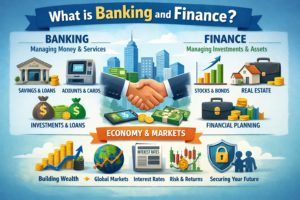
Banking is a financial system that takes in deposits from the public and lends funds to the public, businesses, and organisations. This system serves as a conduit between the saving and borrowing processes.
The prime objective of banks is to offer financial security, liquidity, and credit services. Banks also promote economic development through funding industries, trade, and other infrastructural schemes.
Role of Banking Functions
Fundamentals of Banking
The basic operations of banking involve offering loans and accepting deposits. People place their funds in the bank for security and earn some interest. The bank uses the funds to offer loans to the clients at a higher interest rate.
The process increases the flow of money in the economy and assists in the growth of businesses as well as personal finances.
Other banking functions would be money transfer services, bill payment services, ATM services, online banking, and foreign exchange services. These services make financial transactions simple and swift for customers.
Additionally, banks also offer advisory services, credit cards, and investing-related services for greater convenience for customers.
“Types of Banking” in the Banking and Finance System_
In the modern banking and finance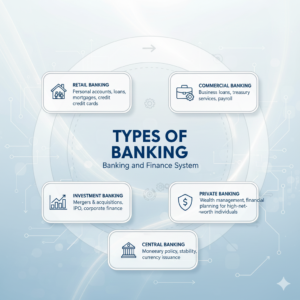
Commercial Banking
Commercial banks are the most commonly known types of banks, which offer various facilities to people. Some of these facilities include savings accounts, current accounts, loans, credit cards, etc.
Commercial banking activities also assume great significance in the financial dealings of a business.
Central Banking
Central banks govern a national monetary system. They manage the money supply, the rate of interest, and inflation. The Federal Reserve in America or the State Bank of Pakistan can be given as examples.
The central bank is responsible for financial stability and the supervision of commercial banks.
Investment Banking
Investment banking primarily deals with major financial transactions involving mergers, acquisitions, and the issuance of stocks. Such banks assist corporations in obtaining finance through stocks and bonds.
Investment banking is an important service in corporate finance and capital markets.
Islamic Banking
In an Islamic bank, transactions are conducted in accordance with the principles of Shariah. These principles do not allow interest. Here, profit-sharing techniques are utilised.
The Islamic banking system has expanded considerably and is also playing a major part in the global banking sector.
“Understanding Finance in Banking and Finance”
What is Finance?
Finance can be defined as the management of money, investments, and risks. Finance includes activities such as planning, saving, investing, and borrowing, and also estimating future financial requirements.
Finance assists people and organisations in making prudent financial choices to ensure stability and growth.
Main Types of Finance
Personal finance
Personal finance is basically managing one’s earnings, spending, savings, and investments. It also encompasses budgeting, pension planning, insurance plans, and tax planning.
Effective personal financial management translates to financial security and stress-free living.
Business Finance
Corporate Finance typically centres on capital management, investments, and financial risk. This entails decisions regarding capital, earnings, and growth.
Sound corporate finance structures can allow corporations to maximise profits.
Public Finance
Public Finance
Government revenue, government expenditure, and management of debt are related to public finance. These aspects pertain to taxation, government budgeting, and government expenditures
Public finance maintains economic stability and development at the national level.
Role of Banking and Finance in the Economy
Role of Banking and Finance in Economic Growth
The role of banking and finance within
The banking and financial sector ensures economic development through the provision of credit to business enterprises and the public. Loans enable entrepreneurs to form businesses that, in turn, create job opportunities.
Financial institutions also encourage savings. This leads to increased investment.
Financial Stability and Security
Banking and finance offer financial security via security against deposits and risks. Various regulations ensure consumer protection and confidence in the finance industry.
A stable banking and finance sector can help in the prevention of economic crises.
Digital Transformation in Banking and Finance
Online Banking and Financial Technology
Digital banking has revolutionised the banking and finance sector. Online banking, mobile banking, and digital wallet services enable customers to conduct their banking operations anywhere and at any time.
Fin-tech innovation has led to greater efficiency, transparency, and consumer experience.
Effect of Technology On Banking And Finance
Technology has minimised the cost of transactions and ensured financial inclusion. Artificial intelligence and blockchain technology revolutionise the management of risks and the payment process.
The future of banking and finance is largely reliant on digital innovation.
Risk Management Practices in Banking and Finance Institutions
Types of Financial Risks
Banking and finance are prone to certain risks, viz. Credit risk, Market risk, Operational risk, and Liquidity risk. These risks need to be managed.
Banks apply sophisticated models as well as regulatory standards to limit financial losses.
Importance of Risk Management
Proper risk management can guard against unexpected losses for both banks and their customers. Sustainability of financial institutions can be ensured.
Risk control is an integral part of contemporary banking and finance methods.
Career Opportunities in Banking and Finance
Banking & Finance Jobs
Banking and finance provide career paths such as bank officers, financial analysts, accountants, auditors, and investment advisors.
These jobs are lucrative and provide opportunities for long-term professional development.
Skills for the Banking and Finance Industry
Analytical skills, knowledge of finance, communication skills, and values qualify a person for a career in banking and finance.
Professional certifications and education are valuable for career advancement in this sector.
Banking and Finance Industry Issues
Disclosure Requirements
Financial institutions have to comply with rigid regulations. This is to safeguard clients. However, these regulations also complicate processes.
An important problem in the financial sector today is regulatory compliance.
Challenges in the Field of Economics and Markets. Economic instabilities and inflation affect the banking and financial sector. Market variability affects investments and profits. Financial institutions need to cope with the ever-changing economic environment. Future of Banking and Finance Emerging Trends in Banking and Finance Digital money, artificial intelligence, and sustainable finance are changing the face of banking and finance. Green finance has gained widespread acceptance. Innovation will continue to shape the financial services industry.
Innovation continues to Career Opportunities in Banking and Finance. The growth opportunities in expanded digital services and financial inclusion are enormous. The emerging markets are fueling the demand for innovative banking and finance solutions. The future of banking and finance is looking promising and dynamic.
Conclusion
Why Banking and Finance Matter
It has become increasingly Banking and finance play a critical role in economic development, financial stability, and wealth generation. They assist people in handling money, facilitate the development of businesses, and ensure that governments function effectively. Whether banking or finance, the involved technologies change dynamically. It is essential to understand banking and finance to make informed financial decisions in creating a bright future. The role of banking and finance will increase in significance as technology improves.
FAQs
What is banking and finance?
Banking and finance refer to the system that manages money, credit, investments, and financial transactions. Banking focuses on deposits and loans, while finance deals with money management, investment planning, and risk control. Together, banking and finance support economic growth and financial stability.
Why is banking and finance important?
Banking and finance are important because they help individuals save money, businesses grow, and governments manage public funds. They ensure smooth money flow in the economy and provide financial security. Without banking and finance, economic development would slow down.
What is the difference between banking and finance?
Banking mainly involves accepting deposits and providing loans to customers. Finance focuses on managing money, investments, assets, and financial planning. Banking is a part of finance, but finance covers a broader range of financial activities.
What are the main types of banking?
The main types of banking include commercial banking, central banking, investment banking, and Islamic banking. Each type serves a different purpose within the banking and finance system. Together, they support economic and financial operations.
What are the main types of finance?
The main types of finance are personal finance, corporate finance, and public finance. Personal finance deals with individual money management, corporate finance focuses on business funding, and public finance handles government revenue and spending.
How does banking and finance help the economy?
Banking and finance help the economy by providing loans, promoting savings, and supporting investments. They create job opportunities and encourage business expansion. A strong banking and finance system leads to economic stability.
What is digital banking in banking and finance?
Digital banking uses online platforms, mobile apps, and electronic systems to provide banking services. It allows customers to transfer money, pay bills, and manage accounts easily. Digital banking has transformed the banking and finance industry.
What skills are required for a career in banking and finance?
A career in banking and finance requires analytical skills, financial knowledge, communication abilities, and ethical values. Problem-solving and decision-making skills are also important. Professional education improves career growth in this field.
Is banking and finance a good career choice?
Yes, banking and finance are excellent career choices with strong growth opportunities. The field offers high-paying jobs and long-term stability. It is suitable for individuals interested in money management and financial analysis.
What is the future of banking and finance?
The future of banking and finance is driven by technology, digital payments, and financial innovation. Artificial intelligence and fintech are shaping modern financial services. The industry will continue to grow and evolve globally.