

North Dakota is one of those rare American destinations where the gap between expectation and reality works entirely in the traveler’s favor. Most people arrive expecting flat and featureless and leave having seen something they genuinely did not anticipate. Volcanic badlands carved into dramatic formations by millions of years of erosion. Free-roaming bison herds moving through valleys without fences. Rivers that look almost exactly as they did when Lewis and Clark paddled through in the early 19th century. A culture built around genuine hospitality rather than tourist performance. This guide covers everything you need to know to plan a meaningful, well-organized trip to North Dakota in 2026, from the best times to visit and the places that deserve your time to practical advice that will keep your journey moving smoothly.
What Makes North Dakota Worth Your Time in 2026?
The straightforward answer is that North Dakota rewards travelers who actually pay attention, and it does so without the crowds, the inflated prices, and the logistical headaches that come with more famous destinations. In 2026 specifically, new interpretive experiences are opening near the Little Missouri Badlands, expanded tribal cultural programming is available along the Missouri River corridor, and the state events calendar is running one of its strongest seasons in recent memory. You get a lot of state for your investment here and very little competition for the best of it.
Choosing the Right Season for Your Visit
Each season in North Dakota offers a fundamentally different version of the state rather than simply a warmer or colder variation of the same experience.
- Late May through early September is the peak season and for good reason. Temperatures are comfortable, wildlife is active across the badlands and prairie, wildflowers cover the grasslands through June, and outdoor events run throughout the region from rodeos to powwows to music festivals.
- Mid-September through October is arguably the finest time for photography and quiet exploration. The cottonwood trees lining the river valleys turn a deep gold, autumn light sits low and warm on the badlands formations, and the waterfowl migration through the Prairie Pothole Region is one of the great natural spectacles of the central flyway.
- Winter brings serious cold and serious rewards for those prepared for it. Devils Lake ice fishing draws dedicated anglers from several states away, and the northern lights make regular appearances on clear nights in the upper counties.
- Spring arrives late and sometimes muddy but delivers exceptional birdwatching and the first fresh green on a landscape that has been grey for months.
The Essential Places to Visit
Theodore Roosevelt National Park
No trip to North Dakota is complete without spending serious time in Theodore Roosevelt National Park. The park splits into a South Unit near Medora and a North Unit roughly 70 miles further north, and the two units feel meaningfully different from each other in character and terrain. The South Unit is more accessible and more dramatic, with a winding scenic road that passes through layered badland formations, prairie dog towns, and open valleys where bison herds graze with total indifference to passing vehicles. The North Unit is quieter and wilder, with fewer visitors and trails that push into genuine backcountry.
Roosevelt first came to the Dakota Territory in 1883 to hunt bison and stayed to ranch after the deaths of his wife and mother on the same day sent him west looking for something he could not name. He later said the man he became in the badlands was inseparable from the president he eventually became. That history is present throughout the park in a way that adds real depth to what is already a compelling landscape.
Top Activities Inside the Park
- Drive the 36-mile South Unit scenic loop at dawn or dusk when the light on the formations is most dramatic and bison are most active near the road.
- Hike the Petrified Forest Loop in the North Unit, a 16-mile backcountry trail that most day visitors never reach and that rewards the effort with complete solitude.
- Visit the Maltese Cross Cabin near the South Unit visitor center, Roosevelt’s original ranch building moved here from its original location and open to viewing.
- Attend a ranger-led program during the summer season for geological and historical context that transforms the scenery around you into a readable story.
Medora
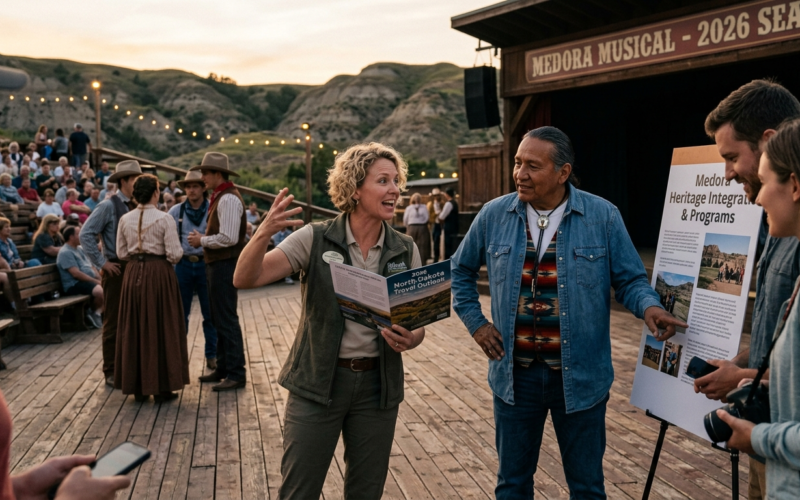
Medora is the kind of small Western town that genuinely earns its reputation rather than trading on nostalgia. Sitting at the entrance to the South Unit of Theodore Roosevelt National Park, it has preserved its late 19th-century character through real buildings and authentic history rather than theme park reconstruction. The Medora Musical is an outdoor summer production that has been running for decades and regularly sells out well in advance. The surrounding landscape, the quality of the local restaurants, and the easy access to the park make Medora the natural base of operations for anyone spending more than a day in western North Dakota.
Knife River Indian Villages National Historic Site
Near the town of Stanton in central North Dakota, this nationally significant site preserves the remains of three Hidatsa villages that were continuously occupied for several centuries before European contact permanently changed the region. It is also where Sacagawea was living when she joined the Lewis and Clark Expedition in the winter of 1804. The museum handles the history with intelligence and care. The reconstructed earthlodge gives visitors a grounded and concrete sense of the sophistication of Plains village life that no amount of written description can fully convey.
Devils Lake
The largest natural lake in North Dakota, Devils Lake has developed a national reputation among serious freshwater anglers. Walleye, yellow perch, and northern pike are the primary draws, and the fishing pressure is remarkably light given the quality of the resource. The lake has been rising steadily for several decades, which has expanded the fishable water significantly and created rich backwater habitat that supports healthy fish populations year-round. The surrounding town has a well-developed infrastructure of guides, outfitters, lodges, and equipment rental operations serving both summer and winter visitors.
Fargo
North Dakota’s largest city has built a genuine urban identity that consistently surprises first-time visitors. The Broadway corridor in downtown Fargo is walkable, independently owned, and full of character, with craft breweries, restaurants sourcing regional ingredients, galleries, and shops that feel like they grew organically from the community rather than being installed. The Plains Art Museum is a legitimate cultural institution with a collection that rivals institutions in cities several times larger. The 1926 Fargo Theatre, fully restored, hosts live performances and film screenings throughout the year.
Practical Advice for Traveling North Dakota
- Fuel up whenever a gas station presents itself in western and rural areas. Stretches of 60 miles or more without any services are not uncommon and the landscape provides no warning before it empties out completely.
- Download offline maps before leaving any town of meaningful size. Cell coverage is unreliable across large sections of the badlands, the western plateau, and the northern tier of the state.
- US Highway 2 running east to west along the northern edge of the state is one of the most underappreciated road trip routes in America. The sky is enormous and the towns along the way are genuinely worth stopping in.
- Weather changes fast in every season. Summer afternoon thunderstorms can become severe with little warning, and winter conditions on open highways can deteriorate from clear to dangerous in under an hour.
- The International Peace Garden on the Canadian border near Dunseith is worth the detour. The formal gardens span both nations and the symbolically unguarded crossing is unlike anything else in North America.
Trusted Resources for Planning Your Trip
For official and continuously updated travel information including seasonal road conditions, a complete events calendar, regional lodging directories, and trip planning tools, visit the North Dakota Tourism Division, the state government’s dedicated resource for visitors at every stage of planning.
FAQs
Is North Dakota a good destination for families with children?
Yes. Theodore Roosevelt National Park, the prairie dog towns, the Knife River earthlodge, and the hands-on exhibits in Bismarck and Fargo all work exceptionally well for younger visitors.
How many days do I realistically need to see the highlights?
Five to seven days gives you enough time to cover the badlands, Medora, Bismarck, and Fargo without rushing. A long weekend works if you focus exclusively on the western parks region.
Do I need to book Theodore Roosevelt National Park entry in advance?
No advance reservation is currently required for general vehicle entry. A per-vehicle fee applies and the America the Beautiful Annual Pass covers it along with all other federal lands.
What Native American cultural experiences are accessible to visitors?
The United Tribes Technical College powwow in Bismarck each September is open to the public and outstanding. The Knife River site and the MHA Nation cultural center near New Town are both excellent options year-round.
